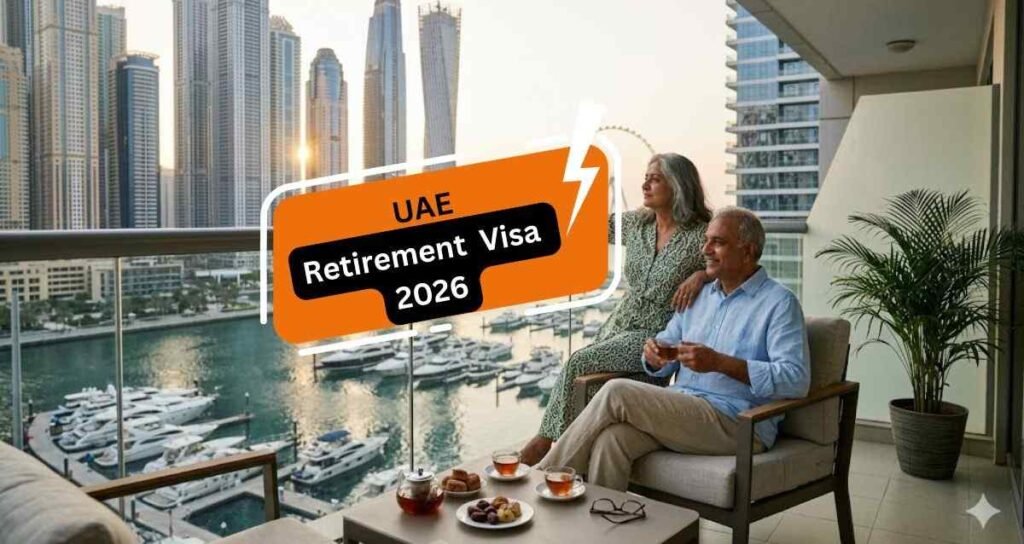
If you are 55 or over and you have 15 years of work behind you, the UAE will give you a five year residence permit with no employer attached. You prove one financial condition and that is broadly it. The permit renews on the same terms.
The catch is the income figure, and it is the single thing readers get wrong. It is not one national number. Through ICP, which handles Abu Dhabi, Sharjah, Ajman and the northern emirates, you need AED 180,000 a year. Apply from Dubai through GDRFA and the bar moves to AED 240,000. That is AED 20,000 a month, and the AED 60,000 gap between the two decides where a lot of people end up living.
Why bother with any of it? Because residency here has always been tied to a job. The day your employment ends, your visa starts counting down, and everything hanging off it goes with it. Bank account. Emirates ID. Tenancy contract. Even your salik and phone line eventually. The retirement visa is what stops that chain reaction.
So What Is It, Exactly
A five year residence permit for retired foreigners, with no work permit attached to it. GDRFA words it well: residency without a sponsor or host inside the country.
No company owns your status. That is the real change. You still do the usual residency circuit, medical fitness test, biometrics, Emirates ID, and you still need health insurance, which is mandatory for residents in both Dubai and Abu Dhabi.
But read the name literally. It is a retirement visa. You can hold shares in a company, take rent from a flat, draw a pension, move your own money around. Take a salaried job in the UAE and you are on the wrong permit.
Who Actually Qualifies
Two gates before anyone looks at your bank statements.
You need to have completed 55 years at the time of retirement. Not 50. I mention it because half the blogs out there still say 50, and people plan around it.
And you need 15 years of work history. Here is the part that surprises people: it does not have to be UAE service. A career spent entirely in Kochi, Cairo or Croydon counts, as long as you can put it on paper. An employment certificate, a pension statement, a letter from an old employer. Something a case officer can read.
The Money Part
Now it splits by emirate.
Through ICP, you either own property worth AED 1 million or more and hold savings of AED 1 million or more, or you show annual income of AED 180,000 from any source, in the country or outside it.
Through GDRFA Dubai it is the same shape, with a higher ceiling on the income route:
- Property in the country valued at no less than AED 1 million, plus a deposit of no less than AED 1 million. The valuation has to come from the competent authority, which in Dubai means the Land Department. What you think your flat is worth does not enter into it.
- Or fixed annual income of no less than AED 240,000, backed by six months of bank statements.
Two clauses in the Dubai rules deserve a second read.
Mortgages are not a disqualifier. A mortgaged title deed is accepted so long as you have already paid at least AED 1 million towards it by the time you apply.
And the savings do not have to be sitting in a UAE bank on day one. If the money is abroad, you have 60 days from the date the residency is issued to move it into a financial institution here, or to invest that amount inside the country. That 60 day window is generous, but it is a deadline, and people forget it once the Emirates ID lands.
What You Have to Hand In
Less than you would expect. GDRFA splits it by route.
Own property: passport copy, and either the title deed or a Land Department valuation.
Have a deposit: personal photo, passport copy, the deposit certificate, and an acknowledgment that the deposit is coming into the country.
Have an income: personal photo, passport copy, six months of bank statements, and a letter from an official body naming the source of that income.
That final letter is where files stall. If your pension is paid by a scheme in London or Manila, request the letter on headed paper now, not when you are ready to submit. Attestation from abroad routinely takes longer than the visit visa decision itself, which is a strange sentence to write, but there it is.
The Application Itself
Three ways to do it in Dubai. Online through GDRFA smart services, which runs around the clock. At an Amer centre, where someone types it up and checks the file before it goes in. Or in person at a GDRFA Customer Happiness Centre, ticket and all.
Online, the order is fixed. Open the GDRFA service page and start the service. Sign in with UAE Pass, or make a GDRFA account with your name, email and mobile. Choose new application, pick the residence permit for the retired foreigner, then select your category. Fill in the details, upload, pay. You get an application number to track it with, and a notification when the decision comes.
In the other emirates, it is ICP smart services or a Tas’heel centre.
GDRFA puts completion at 48 hours for the permit. True enough for the permit, but the medical and biometrics sit outside that clock, so plan on two to three weeks before the Emirates ID is physically in your hand. Steer clear of the days around Eid unless you enjoy queues.
What It Costs
Two published figures matter for the five year permit: residence fees of AED 2,280, and AED 575 for the Emirates ID. Call it AED 2,855.
You will see smaller amounts quoted elsewhere, a AED 200 permit fee, AED 500 for applying in country, ten dirhams each for Knowledge and Innovation, twenty for delivery. Do not stack those on top of the AED 2,280. They are already inside it. The five year figure looks steep next to a short permit because issuance climbs AED 100 for every year past the second one.
The costs that will actually surprise you sit outside the visa file. Medical test, typing charges, and above all insurance. A policy for someone at 58 or 63 does not price like one for a 30 year old in Media City, and anything pre existing pushes it further. Get real quotes before you decide which route you are taking, because for some people the premium changes the maths entirely.
Things Worth Knowing Before You Start
Valuations move, in both directions. If someone told you two years ago that your place in Jumeirah Village Circle was worth about a million, that is a memory, not a document. Get it revalued before you build a file on it.
Watch the currency. The dirham is pegged to the dollar, so if your pension pays in sterling, rupees or rand, a bad year can quietly drag your annual income below AED 240,000 without you doing anything wrong. Sit comfortably above the line rather than exactly on it, and you save yourself a headache at renewal.
Boring bank statements win. Six months of regular deposits from one named source reads cleanly. Lumpy transfers from three different places invite questions you then have to answer in writing.
There is a 60 day grace period to stay in the country after a permit expires or is cancelled. Useful cushion. Terrible plan.
And if AED 240,000 is simply out of reach, stop looking at Dubai. Applying through ICP at AED 180,000 is a different proposition, and a fixed income goes considerably further in Ras Al Khaimah, Ajman or Sharjah than it does anywhere near Downtown. Plenty of retirees settle in Al Hamra or out towards Mirdif and drive in when they feel like the city. Nobody checks that you love your postcode.
After It Is Approved
You can sponsor family, so a spouse and dependent children come under you in the normal way, with the normal requirements.
Mostly, though, the visa just makes daily life work. Banks want to see live residency. So do landlords, DEWA, the telecom providers and every clinic reception. Renewing an Emirates ID against a valid permit takes minutes.
One last practical note. Build your year around the weather. From June to September the outdoors is off the table for most of the day, and a lot of retirees here simply leave, then come back for October through April when the beaches, Al Qudra and the desert weekends are worth the price of admission.
Closing Thoughts
For all the noise around it, this is one of the more straightforward long term permits in the country. The trick is deciding which authority you are applying to first, then working backwards from that figure, instead of assuming one number covers the whole UAE.
Get the income letter moving early, revalue the property, price the insurance honestly, and leave yourself room above the threshold so a currency swing does not complicate things five years from now. Rules do get amended, so check u.ae or the GDRFA service page before you submit anything.
Frequently Asked Questions
What is the minimum age?
You must have completed 55 years at the time of retirement.
How long does the visa last?
Five years, renewable on the same terms it was originally granted.
How much income do I need to show?
AED 180,000 a year through ICP in most emirates. AED 240,000 a year, about AED 20,000 a month, through GDRFA Dubai.
Can I qualify on property alone?
No. The property route pairs property of at least AED 1 million with savings or a deposit of at least AED 1 million.
Does a mortgaged property count?
Yes, if you have already paid at least AED 1 million towards it when you apply. The mortgaged title deed is accepted.
Do my 15 years of work have to be in the UAE?
No. Service inside or outside the country counts, provided it totals 15 years and you can evidence it.
Can I take a job on this visa?
Not a salaried one. You can hold shares, collect rent and manage investments.
Can I sponsor my spouse and children?
Yes, under the standard residency requirements.
Does my savings have to already be in a UAE bank?
No. You have 60 days from the date the residency is issued to transfer it here, or to invest that amount inside the country.
How long does approval take?
GDRFA states 48 hours for the permit. Allow two to three weeks overall once medicals and Emirates ID are factored in.
Do I need health insurance to apply?
You need valid UAE cover for residency. In Dubai you can begin the application and arrange the policy during the medical stage, but it must be in place before the visa is issued.
What if my visa expires?
There is a 60 day grace period to remain in the country after expiry or cancellation.
Where do I apply?
GDRFA smart services, an Amer centre or a Customer Happiness Centre in Dubai. ICP smart services or a Tas’heel centre elsewhere.
Disclaimer: The information provided in this guide is for general informational and educational purposes only. It does not constitute legal, immigration, financial, or professional advice and should not be relied upon as a substitute for official guidance. We are not a visa provider, immigration authority, or government agency, and we do not process, approve, or influence visa or residency applications. UAE immigration laws, eligibility requirements, fees, and procedures may change without prior notice. All decisions regarding the approval, rejection, renewal, or cancellation of any visa or residency application are made solely at the discretion of the relevant UAE government authorities, including the General Directorate of Residency and Foreigners Affairs (GDRFA) and the Federal Authority for Identity, Citizenship, Customs and Port Security (ICP). Applicants should always verify the latest requirements through the official UAE government channels before submitting an application.