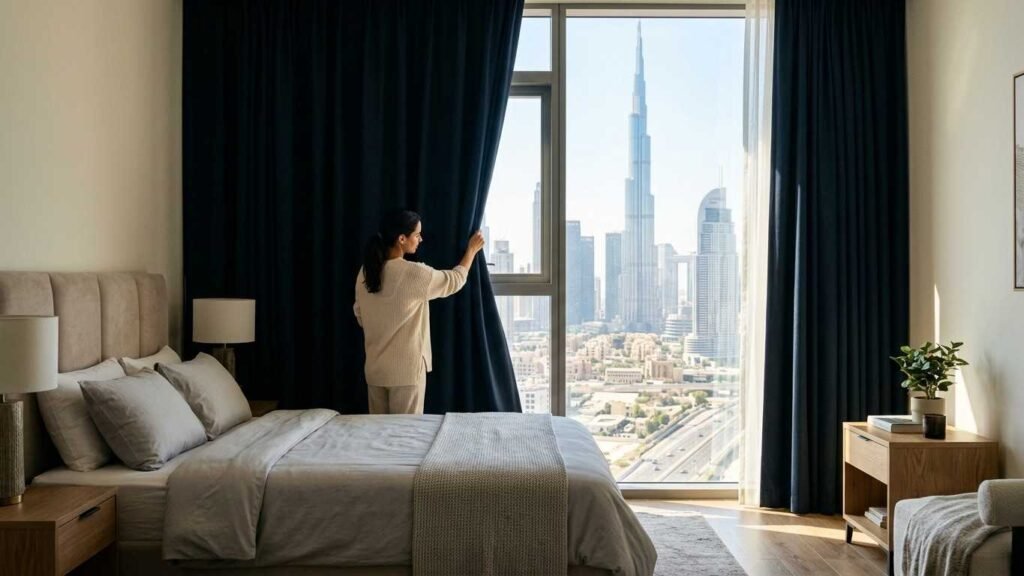
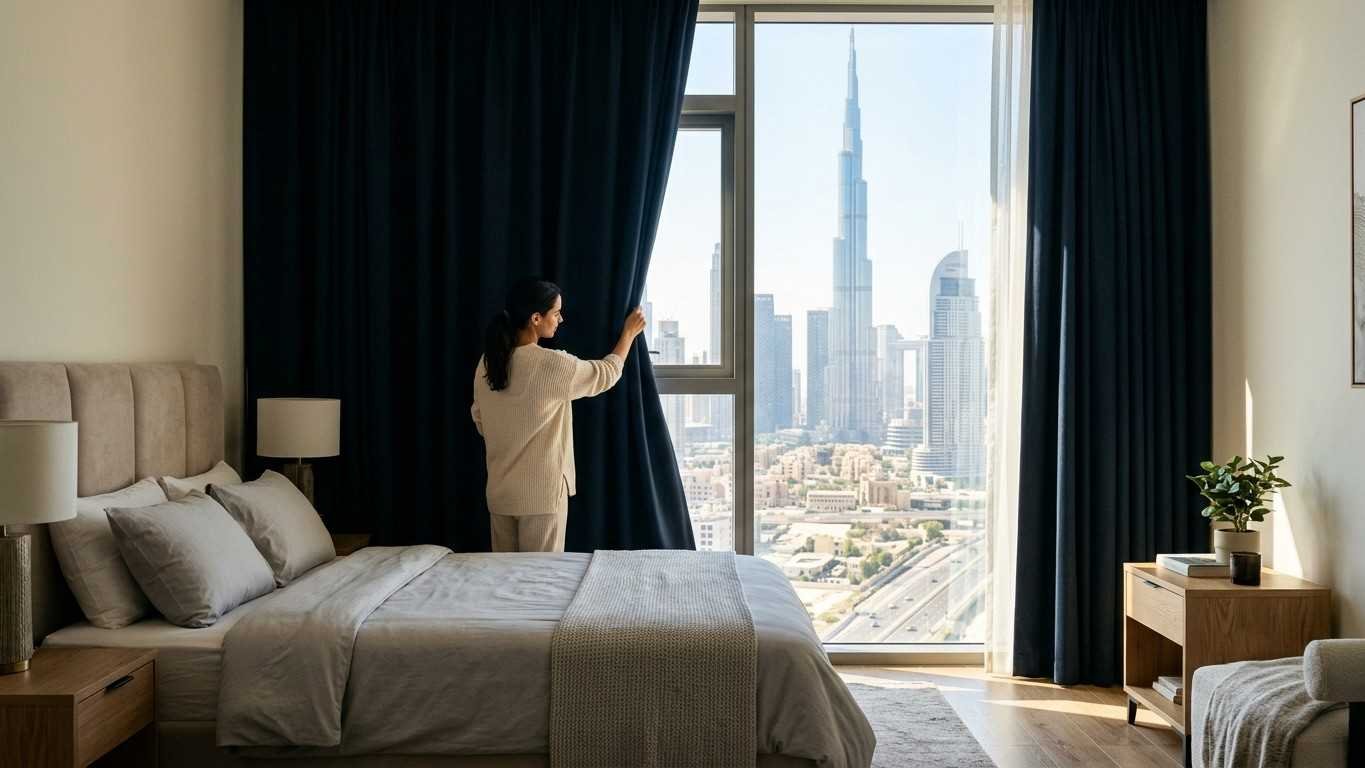
Regular curtains don’t really hold up against the sun here. Most of the year, light comes in strong enough that AC units end up working overtime just to keep pace. Blackout curtains fix that, at least partly, and they’ve moved from a specialty item to something almost every furniture store in the city keeps in stock.
Landlords bring them up during move-in walkthroughs now. Rental listings mention them as a selling point. What used to be an upgrade is closer to a baseline expectation in a lot of buildings.
What they are, Plainly
A blackout curtain is a normal curtain with a dense backing layer attached to the back side. The front fabric looks like any curtain. The back has a coating, foam usually, sometimes a polymer layer, that stops light from getting through. Close them properly and the room goes dark. Not dim. Dark enough that shapes across the room disappear.
Room darkening curtains get mixed up with these often enough that it’s worth separating them. Room darkening still lets some light in. Blackout is built to stop almost all of it. If the goal is a genuinely dark room, room darkening won’t get there on its own.
Who Ends Up Needing Them
Night shift workers sleeping through daylight hours are the clearest case. Parents trying to get a toddler down for a nap while the sun’s still up are another. Light sleepers who wake at sunrise, or from a streetlight, a passing car, or the glow off a neighboring tower, fall into this group too.
Marina and JBR apartments deal with this constantly, since the buildings bounce light off each other and there’s rarely a window that goes fully dark by itself. Anyone familiar with Dubai waterfront living knows that beautiful views usually come with strong sunlight and very little natural shade. A blackout curtain solves that in a way a regular one doesn’t come close to.
Some landlords now install these as standard before a tenant even moves in, because tenants ask for them. Worth checking with the landlord if a rental doesn’t already have them.
The Mechanics, Roughly
Light travels in a straight line until something stops it. Ordinary curtain fabric doesn’t stop much of it at all. The foam layer on a blackout curtain is thick enough to block that light almost entirely, which is not much more complicated than basic physics.
That same foam also traps a thin layer of air between the window and the room. Trapped air insulates. Less outside heat makes it indoors as a result, and that’s the direct reason an AC doesn’t have to work as hard once these curtains are closed.
Why More People are Buying Them
The Heat Problem
A summer electricity bill in Dubai can end up close to rent, sometimes more for a poorly insulated unit. Many residents eventually pair blackout curtains with a dehumidifier for UAE homes, especially during the hottest months, because reducing heat and humidity together usually makes the biggest difference. Blackout curtains cut into that in a measurable way. Rooms with them closed during the day tend to run 5 to 8 degrees cooler than identical rooms without, and a cooler room means the AC cycles less. Less cycling shows up on the bill.
Sleep, Mostly
The city rarely goes fully dark. Streetlights, headlights, building lights and shop signage keep some light coming through most windows through the night. Melatonin production needs darkness to work properly, so cutting that light out tends to improve sleep in a fairly direct way. People switching over after years without blackout curtains often notice a difference within days, not months.
Privacy
Buildings sit close together in most parts of the city. With regular curtains, switching on a lamp at night can throw a clear silhouette against the glass for anyone outside to see. Blackout fabric is fully opaque, so that problem goes away. Matters most on ground floors or units facing a street or a parking lot.
Noise
Heavy fabric absorbs some sound, though not all of it. Traffic and construction noise come through quieter, and that’s noticeable near Sheikh Zayed Road or close to any active building site. Not soundproofing. Still a real difference.
Keeping Furniture from Fading
UV light bleaches fabric, wood, and artwork over time, and Dubai gets a lot of direct sun exposure through untreated windows. A blackout lining blocks UV almost completely, which keeps furniture and flooring from fading the way they would behind a thin, unlined curtain.
Picking the Right Ones
Quality, First
Cheap blackout curtains flood the market online. Most don’t last. The lining tends to peel within a year or so, and once that starts, light finds its way back in. Paying more upfront for a properly made one is usually worth it, since these are meant to stay up for years, not one season.
The Backing Matters More than the Front
The front fabric is decoration, nothing else. The backing is where the actual work happens. A three-pass lining, meaning the coating got applied three separate times, tends to block more light and insulate better than a single-pass version. The front material itself can be velvet, linen, polyester, whatever fits the room. Synthetic fabrics generally hold up better under constant sun than natural fibers do, even though a cotton blend often feels nicer to the touch.
Getting the Measurements Right
This is where most installs go sideways. Measuring just the window frame and buying to that exact size leaves gaps at the edges where light gets in. Panels need to run at least 4 inches past the frame on each side, and reach close to the floor. When unsure, buy larger rather than smaller. A curtain can be hemmed shorter. It can’t grow back once it’s cut.
Rods
A standard rod leaves a gap between the fabric and the wall, and light finds that gap without much trouble. A wrap-around rod, sometimes called a French return rod, curves back toward the wall so the fabric seals against it instead of hanging away from it. Costs more. Closes a gap a normal rod leaves wide open.
These curtains are heavier than most people expect, too. Wall anchors need to be rated for that weight, since lightweight anchors meant for sheers can pull straight out of drywall over time.
Two Rods, Not One
A fairly common setup uses two separate rods, a sheer on one and a blackout panel on the other. During the day, the sheer stays shut while the blackout opens, which lets light in without giving up privacy. At night, both close. The sheer also shields the blackout panel from constant direct sun, which helps it last longer.
Keeping them in Shape
Vacuum the panels weekly with a brush attachment so dust doesn’t build up in the weave. Deal with stains right away using a damp cloth and mild soap, and go easy on the backing when cleaning, since the foam scratches without much effort and any scratch there becomes a spot where light gets through.
Check the label before washing anything. Most blackout curtains need dry cleaning. If a label does say machine washable, cold water on a gentle cycle is the safest bet, no hot water, no dryer, since heat melts the foam backing outright. Air dry in the shade instead. Given the climate here, a dry cleaner is often the safer, if pricier, option.
The Short Version
Blackout curtains deal with a specific set of problems that show up constantly in Dubai: heat, light, noise, privacy. Installed with the right hardware and measured properly, they make a real, noticeable difference to how a room feels, how well people sleep in it, and what shows up on the electricity bill at the end of the month.
Frequently Asked Questions
Do blackout curtains really keep the heat out in Dubai?
Yes. The foam backing blocks sunlight, which keeps the room cooler and takes pressure off the AC. Rooms with them closed during the day often run 5 to 8 degrees cooler, and that tends to show up as a lower electricity bill over time.
Can I wash blackout curtains in a washing machine?
Depends on the label. Most call for dry cleaning. If machine washable is listed, cold water and a gentle cycle work, but skip the dryer entirely, since heat can damage the foam backing for good.
Are blackout curtains heavy?
Yes, noticeably more than a standard curtain, because of the dense lining. Regular rods and lightweight anchors often aren’t strong enough, so heavier hardware usually needs to go in alongside them.
Do blackout curtains block out street noise?
They muffle it rather than remove it completely. Traffic and construction sounds come through quieter, and most people notice that within the first day or two, even though it’s not true soundproofing.
How do I stop light coming in from the sides of blackout curtains?
A wrap-around rod keeps the curtain flush against the wall, and panels wider than the window frame help close the remaining gap. Light gets through any small opening it can find, so sealing the edges matters just as much as the fabric choice itself.
What is the difference between room darkening and blackout curtains?
Room darkening lets some light through still. Blackout blocks nearly all of it. For a room that needs to go fully dark, blackout is the right pick. Room darkening costs less but doesn’t perform well in a climate as bright as Dubai’s.