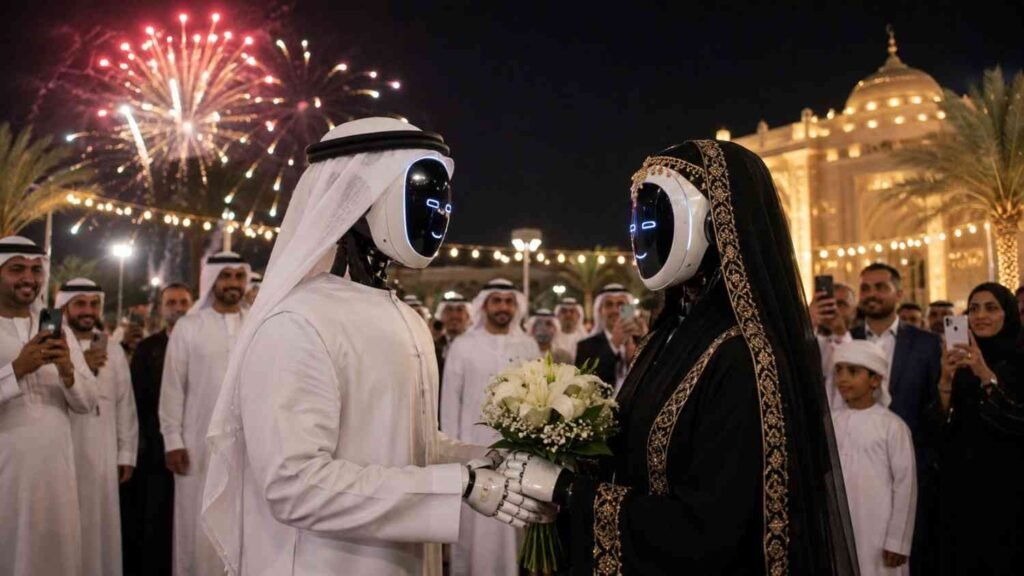
So here’s something that actually happened. On August 1st, a robot got married in the UAE. Not a metaphorical thing. An actual humanoid robot named Bu Sunaidah tied the knot with another robot called Moza. Pretty wild, right?
The whole thing went down with all the traditional trappings. There was music, fireworks, dancing. People dressed the groom in a Kandura. The bride wore an abaya. If you didn’t know better, you’d think it was just another wedding. Except both the bride and groom were made of metal and circuits.
Bu Sunaidah is a Unitree G1 robot built by Lootah Robotics. He’s about 1.27 meters tall, weighs 35 kilograms, and speaks Arabic. That last part matters. He’s not just some generic robot. He’s been programmed to actually fit into Emirati society. Over 12,000 people follow him on Instagram. He’s kind of become a thing.
The Wedding Itself
Let’s talk about what actually happened at this wedding. The ceremony followed the usual Emirati traditions. Guests helped Bu Sunaidah get ready, putting on his white Kandura. Moza showed up in traditional dress with a headscarf and ribbons. They exchanged vows while “Edkhely Omri” by Hussain Al Jassmi played. That’s a famous wedding song in the region.
The Celebration and Public Reaction
Then came the celebration part. Fireworks went off. People did the traditional stick dance. The whole scene got documented and posted to Instagram. The comments were split. Some people thought it was cool. Others made jokes about being single while robots were getting married.
Why Build a Robot Like This?
Lootah Robotics didn’t just make Bu Sunaidah for fun. The company built him to show what robots can actually do. They wanted to demonstrate that machines could handle more than factory work. The goal was to prove robots could interact with people in meaningful ways, especially in cultural contexts.
Bringing Robots Into Everyday Life
Bu Sunaidah has been making appearances around the UAE for a while now. He showed up at a mosque during Eid Al Adha and prayed alongside the congregation. He does morning runs. He exercises. These aren’t random stunts. They’re deliberate attempts to normalize robots in everyday situations.
The approach is actually smart. When people see a robot dressed in traditional clothes doing normal things, it becomes less weird. The shock factor goes down. People get comfortable with the idea faster.
We’re already seeing this shift happen across the country. Whether it’s businesses experimenting with automation or workers becoming more comfortable with new tools, AI adoption across the UAE is accelerating much faster than many people expected.
How Do You Even Program Something Like This?
Getting a robot to work in social situations is actually pretty complicated. The developers had to teach Bu Sunaidah to understand Arabic. Not just recognize words, but actually comprehend context and respond appropriately. They programmed his movements to match cultural expectations. He can’t just move however he wants. Every gesture has to make sense in the context of Emirati traditions and social norms.
Teaching Robots to Understand Culture
The team spent considerable time studying local customs. They thought through everything from how he should greet people to how he should dress to how he should behave in different situations. The goal was to create something that felt like a natural addition to society, not something weird or threatening that would make people uncomfortable.
Why Real World Testing Matters
There’s a practical benefit too. When robots work in unpredictable real-world situations, developers learn what breaks and what works. They get data they can’t get in a lab setting. That information helps them build better robots next time around. A wedding is perfect for this because it throws everything at the robot at once. Different lighting. Noise. Crowds. Unexpected interactions. If it works there, it’ll probably work in lots of other places.
Looking at projects like this, it’s easy to see that robots aren’t developing in isolation. They’re being supported by increasingly powerful computing systems, data networks, and sovereign AI infrastructure, which gives countries greater control over how artificial intelligence is developed and deployed.
Why Go Through All This Trouble?
Companies host robot weddings for a few reasons. First, it gets attention. Media covers it. People talk about it. That’s free publicity for the company. In a world where everyone’s fighting for attention, something like a robot wedding is gold. It’s unique. It’s memorable. People share it.
A Powerful Way to Showcase Technology
Second, a wedding is genuinely complicated from a technical standpoint. There’s weird lighting. Loud noises. Crowds. Unexpected situations. Guests might touch the robot. Someone might ask it questions. The music might be too loud. If a robot can handle a wedding, it can probably handle lots of other social scenarios too. It’s a good test of what the technology can actually do in the real world.
Real World Engineering Challenges
Third, there’s the engineering angle. Testing in the real world beats testing in a lab every single time. You find problems you wouldn’t find otherwise. You get real data about how the robot performs under pressure. A lab is controlled. A wedding is chaos. That’s why it matters.
Other Places Are Doing This Too
The UAE isn’t alone in experimenting with robot weddings. Russia had two robots, Robert and Matilda, get married at a library in Moscow. They exchanged AI-generated vows. A government official declared them robot spouses. It was a whole thing. Got media coverage across Europe. People were talking about it.
How Russia Introduced Robot Weddings
India took a different route. Instead of having robots be the bride and groom, they used robots as helpers at weddings. The robots greeted guests as they arrived, handed out sweets, played music, entertained the kids. Different approach, same basic idea: showing what robots can do in social settings. Instead of being the main event, they’re supporting the event.
A Growing Global Trend
The fact that this is happening in different countries with different cultures suggests something bigger is going on. Robots are becoming part of how humans celebrate things. Tech companies in Asia, Europe, and the Middle East are all experimenting. Whether that’s good or bad depends on who you ask. But it’s definitely happening.
What’s Next for the UAE?
The robot wedding signals that the UAE is serious about technology. The government backs innovation. Companies are investing in robotics. People are getting used to seeing AI in their daily lives. It’s not like this is happening overnight, but the trajectory is clear.
Bu Sunaidah’s appearances have been gradual. First the mosque. Then the morning run. Now a wedding. Each one normalizes robots a bit more. It’s intentional. The idea is to get people comfortable before robots become really common. You introduce them slowly. You show they’re helpful. You demonstrate they respect local culture. Then people are ready for the next step.
You’ll probably start seeing robots in more places over the next few years. Hotels could use them to greet guests and provide information. Restaurants might have robot servers or kitchen assistants. Hospitals could deploy them to help with patient care or logistics. Shopping centers could have robots providing directions. The possibilities are pretty much endless once you start thinking about it.
In some ways, this transition has already started. The expansion of autonomous technologies in Abu Dhabi shows how quickly the country is integrating artificial intelligence into everyday services, transportation systems, and public infrastructure.
But this shift needs rules and regulations. Governments have to figure out how to regulate AI in public spaces. What are the safety requirements? What about liability? Companies need to think about ethics and safety. Workers need to adapt to new job environments. It’s a lot to sort out, and there’s no perfect playbook yet.
For tech companies in the region, there’s a real opportunity here. A robot that understands local language and culture has a significant edge over generic robots built for Western markets. Lootah Robotics is already proving this approach works. Other companies will follow. The ones that get it right will have a competitive advantage.
Questions People Ask
What’s the robot’s name?
Bu Sunaidah. Lootah Robotics built him.
Who did he marry?
A robot named Moza. The wedding happened on August 1, 2026.
What kind of robot?
Unitree G1 model. 1.27 meters tall. Weighs 35 kilograms.
Where can I watch it?
Bu Sunaidah’s Instagram account has the footage.
Why did they do this?
To show what robots can do in social settings. It’s also a test of the robot’s abilities in complex situations.
Are other robots getting married?
Russia had one in 2026. India used robots at weddings to help out. The trend is spreading.
Will this become normal?
Hard to say. Right now it’s rare and mostly for demonstration purposes. Depends on how tech develops and what people want.
What about jobs?
Some jobs will change. Some might disappear. But new technology usually creates new jobs too. History shows that pattern.
Is this good or bad?
Depends who you ask. Some see it as progress. Others have concerns. Both views make sense.