The UAE’s National Centre of Meteorology (NCM) has launched the country’s first agentic AI assistants to enhance weather forecasting, early warnings, and climate services. Powered by intelligent automation while keeping experts in control, the initiative improves forecasting accuracy, operational efficiency, and decision-making, reinforcing the UAE’s leadership in AI-driven meteorological innovation.

The UAE’s National Centre of Meteorology has deployed two Agentic AI assistants, Al-Rasid and Forecaster Assistant, to work alongside human meteorologists. These tools process real-time data from satellites, radars, and observation stations to speed up early warnings and improve forecast accuracy. Human experts still make every final call. This article breaks down how the system works, who it helps, and where the NCM is taking it next.
Think about the last time a sudden rainstorm caught you off guard. Maybe you were driving, or had outdoor plans. Now imagine the team responsible for warning you about that storm is sifting through data from dozens of satellites, hundreds of ground stations, and multiple global weather models, all at the same time, all in real time.
That is the daily reality for meteorologists at the UAE’s National Centre of Meteorology. The volume of incoming data is enormous, and the window to act on it is narrow. A delayed alert is not just an inconvenience. In a country where flash floods, dense fog, and sandstorms can develop quickly, it can be a genuine safety issue.
This is the problem the NCM set out to solve when it launched the country’s first Agentic AI assistants for the meteorological sector. The goal was not to hand the job over to machines. It was to give the people doing the job better tools to work with.
What is Agentic AI and Why Does it Matter Here?
Agentic AI is not a single program that runs one task. It is a network of intelligent agents that work together, each handling a specific function, all feeding into a shared operational picture. Think of it less like a calculator and more like a well-coordinated team that never sleeps.
At the NCM, these agents are built to do the heavy lifting on data processing, pattern recognition, and report drafting. They do not make decisions. That responsibility stays with the meteorologists. What the AI does is clear the path so that human experts can focus on the judgment calls that actually matter.
The NCM has been clear about this from the start. Dr. Abdulla Ahmed Al Mandous, Director General of the NCM and President of the World Meteorological Organization, put it plainly: “We do not see artificial intelligence as a substitute for human expertise, but rather as a knowledge partner that enhances the capabilities of specialists by providing more advanced tools for data analysis, risk assessment, and timely decision-making.”
That framing matters. It tells you exactly what this system is and what it is not.
How Does Al-Rasid Actually Work?
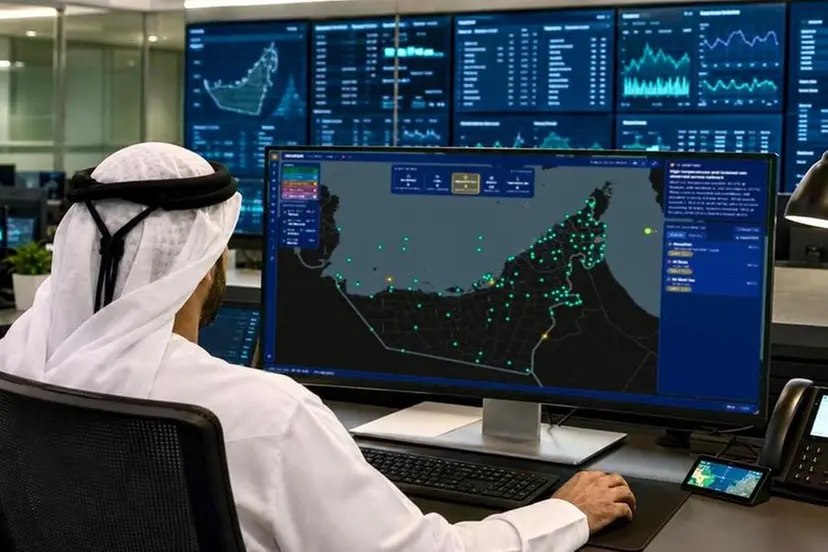
Al-Rasid is the NCM’s continuous monitoring and early warning assistant. The name itself signals its purpose. It runs around the clock, pulling in data from weather observation stations, radars, meteorological satellites, seismic monitoring networks, and air quality stations across the country.
When something unusual shows up in that data, Al-Rasid does not wait to be asked about it. It flags the anomaly immediately with a visual alert so the relevant specialist can take a look. It also generates a live national weather briefing and a forward-looking summary of what conditions are expected over the coming days.
For a forecaster sitting in an operational center, this changes the workflow significantly. Instead of manually scanning feeds from multiple sources to piece together a picture, they get a consolidated, up-to-date briefing the moment they need it. The time saved on data gathering is time gained for actual analysis.
What Does the Forecaster Assistant Do Differently?
Where Al-Rasid focuses on monitoring and alerting, the Forecaster Assistant is built around the forecasting process itself. Its job is to support the numerical weather prediction workflow, which is the backbone of modern meteorology.
It monitors the flow of incoming prediction data, checks that processing is running correctly, and then compares outputs from multiple global forecasting models side by side. When those models disagree, which they often do, the Forecaster Assistant highlights the discrepancies and flags areas of forecast uncertainty.
It also handles the early drafting of weather and marine bulletins and produces a dashboard that maps out potential hazards over the coming days. This is not a finished product. It is a starting point that gives forecasters a structured base to work from rather than a blank page.
The practical effect is that meteorologists can spend more of their time on the science and less on the administrative groundwork that surrounds it.
Who Actually Benefits from This System?
The people who benefit most are not just the meteorologists inside the NCM. The ripple effect reaches much further.
Residents across the UAE get faster, more accurate weather alerts. When a fog advisory or flash flood warning needs to go out, the speed at which the NCM can process data and issue that alert directly affects how much time people have to respond.
Aviation and maritime operations depend heavily on precise, timely weather information. Airlines planning routes and shipping companies managing schedules both rely on the quality of NCM bulletins. A more accurate bulletin, produced faster, has real operational value.
Emergency services and government agencies benefit from the proactive hazard dashboards the system generates. Knowing what is likely to develop over the next few days allows resources to be positioned before a situation escalates.
And for the meteorologists themselves, the benefit is focus. Less time on repetitive data tasks means more time on the complex analysis that requires human expertise.
| Stakeholder | Direct Benefit |
|---|---|
| General Public | Faster, more accurate weather alerts and early warnings |
| Aviation and Maritime | More reliable weather and marine bulletins for operational planning |
| Emergency Services | Proactive hazard dashboards for resource deployment |
| Meteorologists | Reduced administrative load, more time for scientific analysis |
What Comes Next on the NCM’s Roadmap?
The current deployment of Al-Rasid and the Forecaster Assistant is the first phase of a broader plan. The NCM has outlined a roadmap that extends Agentic AI into several other operational areas over time.
Climate services, multi-hazard early warning, air quality monitoring, aviation meteorology, seismology, and media communications are all on the list. Each of these domains involves its own data streams, its own workflows, and its own set of challenges. The NCM’s approach is to expand gradually, ensuring each new deployment is properly integrated and governed before moving to the next.
Governance is a significant part of this. The roadmap is backed by a framework that covers data protection, explainability of AI outputs, full traceability of decisions, and ongoing performance evaluation. These are not optional extras. They are built into the structure of how the system operates, which is what responsible AI deployment in a public safety context actually requires.
Frequently Asked Questions
What is an Agentic AI assistant and how is it being used for weather forecasting in the UAE?
An Agentic AI assistant is a network of intelligent agents that work together to handle specific tasks autonomously. At the NCM, these agents monitor real-time meteorological data, flag anomalies, compare forecasting models, and draft preliminary reports so that human meteorologists can focus on analysis and decision-making.
Will AI replace meteorologists at the UAE’s National Centre of Meteorology?
No. The NCM has been explicit that AI is a support tool, not a replacement. Every output generated by the AI is reviewed and approved by qualified meteorologists before it is acted on or published. Human experts retain full authority over all final decisions.
How does Al-Rasid help improve early weather warnings in the UAE?
Al-Rasid monitors data from radars, satellites, and observation stations around the clock. When it detects unusual patterns or threshold breaches, it immediately alerts the relevant specialist with a visual flag. This reduces the time between a developing weather event and the issuance of a public warning.
What data sources does the Forecaster Assistant analyze?
The Forecaster Assistant works with numerical weather prediction data, comparing outputs from multiple global forecasting models. It checks for processing errors, identifies where models disagree, and highlights areas of forecast uncertainty to help meteorologists make more informed calls.
Is the NCM planning to expand AI into other areas beyond weather forecasting?
Yes. The NCM’s roadmap includes expanding Agentic AI into climate services, air quality monitoring, aviation meteorology, seismology, multi-hazard early warning, and media communications. Each expansion will be phased and governed by a framework that ensures data protection and accountability.
How does the UAE’s NCM ensure AI-generated weather data is accurate and trustworthy?
The NCM operates under a governance framework that requires all AI outputs to be reviewed by qualified specialists before use. The framework also mandates explainability of AI decisions, full traceability of processes, and continuous performance monitoring against defined benchmarks.