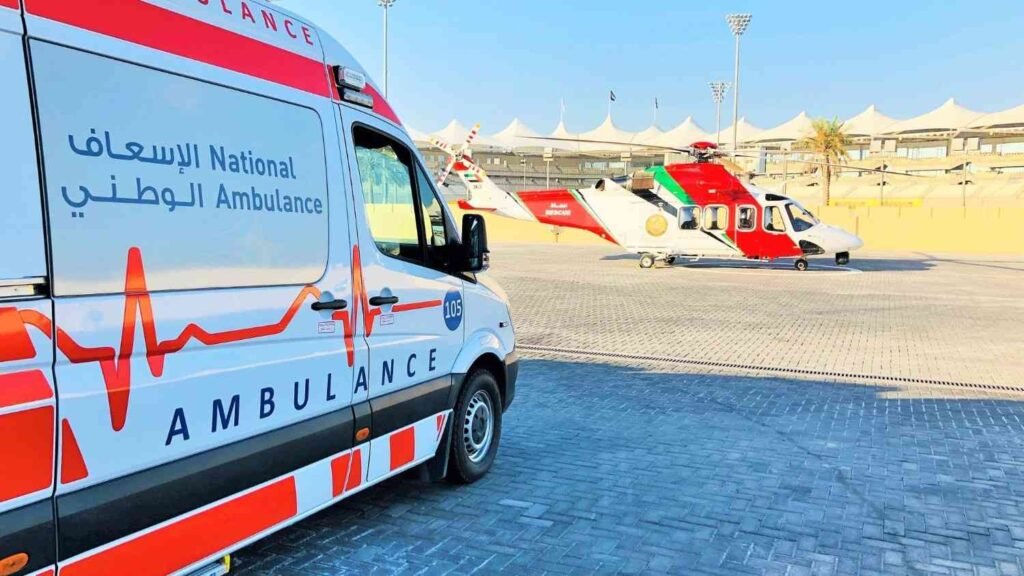
Man, I had this conversation last week that kind of blew my mind. A guy I know, let’s call him Tariq; got T-boned right near the Sharjah border. Pretty bad wreck. His sedan was completely trashed. Anyway, he managed to call 998, and he swears to me an ambulance pulled up in maybe seven, eight minutes tops. Which, if you know the traffic around there, sounds almost impossible. But he was raving about the paramedics. No running around, no shouting. Just pure, focused competence. They patched him up, got him stabilized, and had him on the way to the ER before the adrenaline crash even hit him.
It got me wondering how they pull that off, so I started poking around online. The stats I found are honestly staggering. Just looking at the first half of 2026 six months! These crews dealt with more than 73,000 emergency calls. If you do the math, that’s roughly 400 people calling for their lives every single day. Four hundred. Every day. It’s wild to think there’s this massive, relentless operation running 24/7 while the rest of us are just stressing over emails or what to have for lunch.
Who’s Actually Picking Up the Pieces?
It’s a funny thing; nobody gives a second thought to an ambulance until they’re the one bleeding on the pavement or watching a family member collapse. But the National Ambulance is essentially the safety net for five entire emirates: Sharjah, Ajman, Ras Al Khaimah, Fujairah, and Umm Al Quwain. Heart attacks, massive highway pileups, strokes, someone falling off a ladder… whatever the nightmare is, they’re the ones driving into it.
They’ve been running this show since 2010. What I found super interesting is that they don’t play the whole “territory” game. In a huge disaster, the absolute worst-case scenario is different agencies showing up and arguing over who’s in charge. Because they run everything through a central dispatch, the cops, the fire crews, and the medics all roll up together, working off the exact same playbook.
And look, if you live or work out here, this isn’t just neat trivia. It’s real life. If you run a business, it’s a massive relief knowing that if one of your guys has a medical crisis on the clock, there’s a heavy-duty system ready to swoop in.
How Do They Actually Get There That Fast?
Speed isn’t about having a driver with a heavy foot. It’s entirely about geography. They’ve got 60 stations sprinkled across those five emirates. And they didn’t just throw darts at a map to pick those locations. They crunched the numbers, found out exactly where the worst accidents happen, and literally built their stations right there.
When you punch in 998, you get the Ambulance Communication Centre. These dispatchers took nearly 169,000 calls in just six months. They don’t guess who to send. They use GPS to instantly lock onto the absolute closest rig and dispatch it. The whole game is about getting a trained professional there in those first few minutes. Because let’s be real, that’s the only time it actually matters.
Obviously, the cities are packed with more stations because that’s where the crowds are. It’s just smart, data-driven logistics.
AI: Actually Doing Something Useful
Everybody talks about AI now. Most of it is just tech-bro hype. But these guys are actually using it to fix massive logistical headaches. Down at their Abu Dhabi HQ, the system knows exactly where every single ambulance is, how much gas is in the tank, and what gear is loaded in the back.
But here’s the kicker: the AI actually studies traffic jams and past accidents to predict where the next disaster is going to happen. It’s the same kind of intelligent traffic management that’s already shaping the autonomous vehicle control room in Abu Dhabi, where live data is used to make faster decisions before problems escalate.
They also use it for the boring stuff, like inventory. Medical supplies run out. Fast. The system watches what’s in the trucks and screams if something is running low. I know it sounds dull, but imagine a paramedic needing a specific med to restart a heart, opening a drawer, and finding it empty. The AI stops that from happening.
The “Golden Minutes”
Pre-hospital care is exactly what it sounds like, the stuff they do to keep you alive before you ever see a hospital. Stopping catastrophic bleeding, managing agony, doing chest compressions. In just half a year, they did this for nearly 59,000 people.
Those first few minutes dictate everything. If your dad is having a stroke, paramedics can start treating him right there on the rug. The difference between getting help at minute five versus minute twenty is everything. It’s the whole ballgame.
That broader focus on prevention instead of simply reacting is becoming a pattern across the country. Whether it’s public health, emergency planning, or the UAE’s progress in the Environmental Performance Index, the emphasis is increasingly on using data to reduce risks before they turn into bigger problems.
Why the Team-Up Matters
Real emergencies are an absolute mess. Picture a bad highway crash; you’ve got people trapped in crushed metal, maybe a fire starting, traffic backed up for miles. You need medics, firefighters, and cops all moving in sync.
Because the National Ambulance is wired into the same dispatch as the police and fire departments, they all get the call simultaneously. During major disasters, they all fall under the National Emergency Crisis and Disasters Management Authority. It creates a rigid chain of command. It takes what should be pure chaos and turns it into a machine.
The Brains of the Operation
The whole thing is run out of their headquarters down in Abu Dhabi. It’s this massive complex; a 24/7 comms center, a training academy, gigantic supply warehouses, and the fleet.
The comms center never closes. Ever. The warehouses make sure every rig that rolls out is packed to the gills. And the ambulances? They’re basically rolling ERs. They have the gear to let paramedics do serious, heavy-duty medical procedures right on the asphalt. It’s an incredibly slick system, built for exactly one purpose: showing up when your life is falling apart.
Quick Questions Answered
What’s the number for a medical emergency in the UAE?
998. That’s it. Available 24/7.
Where exactly do they operate?
Sharjah, Ajman, Ras Al Khaimah, Fujairah, and Umm Al Quwain. They’ve got 60 stations across those areas.
How busy are they really?
In the first half of 2026, they took over 73,000 calls and treated nearly 59,000 people. That’s about 400 calls a day.
Are they actually using AI?
Yeah. It helps them predict where to park ambulances based on traffic, and it tracks their medical supplies so they never run out.
Who’s actually in charge?
The National Guard Command. If there’s a massive disaster, they work under the National Emergency Crisis and Disasters Management Authority.
What do they respond to?
Everything. Car wrecks, heart attacks, bad falls, fires. If it’s medical, they go.
How fast do they get there?
Depends on traffic, but the GPS sends the absolute closest truck. In the city, it’s usually just a few minutes.
Do they train regular people?
Yes. They have a training center with real, accredited courses for both medical pros and regular folks.
What is pre-hospital care?
It’s the stuff paramedics do before you get to the hospital; CPR, stopping bleeding, pain meds. It literally saves lives.
How do they work with the cops and fire department?
They share a dispatch system. You call 998, and everybody who needs to be there gets sent at once.
Is it free?
It’s part of the emergency system here. If you need help, call 998. Don’t stress about the bill when you’re dying.