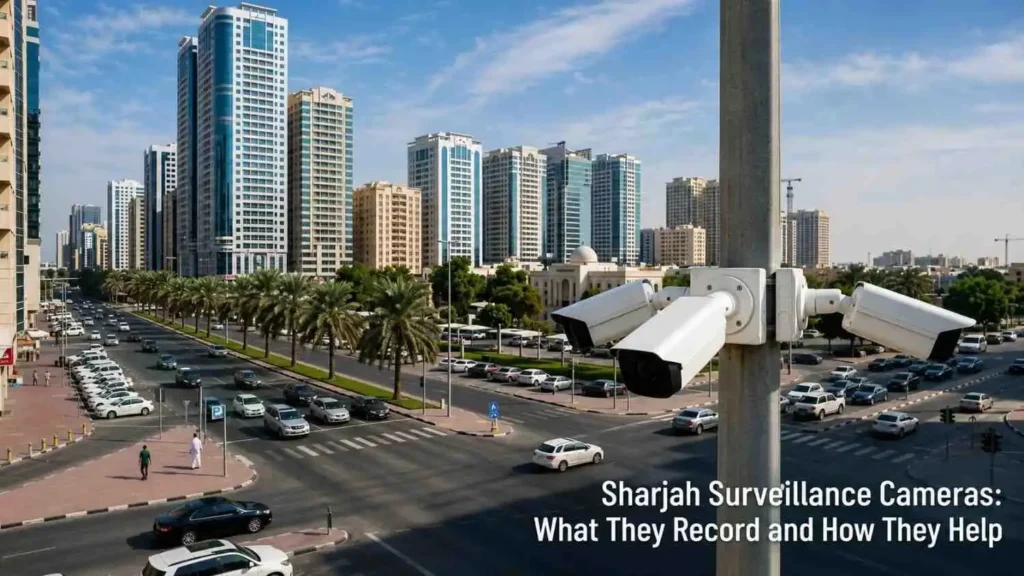
Sharjah Surveillance Cameras: What They Record and How They Help
Sharjah Police operate 172,544 surveillance cameras to investigate crimes, track vehicles and verify road incidents. Public footage is only retrieved after an official police report, while banks, exchange houses and jewellery shops must install approved CCTV systems or face fines of up to Dh15,000.
Sharjah Police operate 172,544 surveillance cameras. They use them to identify people after a crime, to follow vehicles across the emirate, and to work out what happened when two drivers give two versions of the same collision.
None of that does you any good unless you know how the footage gets looked at, which is the part nobody explains. You cannot request a recording yourself. Police retrieve it, and only for a case that is already open, so the way you report an incident decides whether the camera that watched your car is worth anything to you.
Owners of certain businesses have a separate obligation. The law tells them to install a system of their own and connect it to the police operations room, and the penalty for skipping it starts at Dh5,000.
Who this is for
Drivers get the most practical use out of it. Somebody clips your car in a car park and keeps going, or the space outside your building is empty in the morning, and there is a reasonable chance the vehicle is on record somewhere in the network. Whether that record turns into anything at all depends almost entirely on how you report it.
Businesses Have Different CCTV Obligations
Business owners in banking, money exchange and jewellery fall under a rule written specifically for them. More on that below.
Then there are the arguments that never become criminal cases. Police have pulled recordings to settle disagreements between a shop and a customer, or a company and an employee, where nobody broke any law and each side remembered the afternoon its own way.
How the Network Works
The system combines three kinds of technology and it runs around the clock. Analytical cameras pick out unusual activity without anyone sitting in front of a monitor. Automatic number plate recognition, or ANPR, reads plates as traffic goes past, which is how police follow one car from camera to camera rather than losing it at the first roundabout. Early warning systems push alerts into the operations room while things are still happening.
Why Image Quality Matters More Than Camera Numbers
The picture is sharp enough to read a plate and make out a face. That detail matters more than the camera count does. A hundred thousand soft, grainy frames prove nothing in an investigation, and Sharjah’s are not soft.
Lieutenant General Abdullah Mubarak bin Amer, Commander-in-Chief of Sharjah Police, described the value of it in fairly ordinary language. Officers do not have to work from assumptions, because the footage tells them which direction the investigation should take.
Call it in the same day, and give Sharjah Police a time and a direction of travel. Most reports fall apart on that second point. Nobody trawls 172,544 feeds looking for your car. Officers pull footage from cameras along a route, so a report like “about 7:40 in the evening, heading towards Al Nahda, silver sedan, turned left at the lights” gives them something to work with. “Sometime this evening near my building” does not.
Why Timing and Accurate Details Matter
Partial information is still information. Three digits of a plate, a colour and a rough timestamp is enough for ANPR to start narrowing things down. And there is no advantage in waiting a week to see whether the other driver has second thoughts, because storage does not last forever and older footage gets harder to recover.
Swapping the plate does not work either. A driver in Sharjah hit a pedestrian, drove off, changed to a fake plate and then threw the fake away. The cameras followed the car through all of it. He confessed once police put the recording in front of him.
Cases travel between emirates too. A vehicle stolen in Abu Dhabi was recovered after Sharjah’s cameras caught it coming into the emirate, and officers tracked its movements until they could make the arrest. Anyone shopping for a used car in the UAE has a good reason to check plate history for much the same reason.
What the Road Cameras are Watching for
Speed is only part of it. Sharjah Police have been clear that the point is changing driver behaviour rather than collecting fines, and the system is set up accordingly. It records patterns over weeks instead of isolated moments. One motorist committed the same violations again and again on a single Sharjah road across a month, denied all of it when he was called in, and the recordings closed the argument.
The network also catches things that have nothing to do with traffic at all. Begging, illegal street vending, vandalism, and vehicles mixed up in serious accidents.
The Rule for Businesses and What Ignoring it Costs
Businesses classed as vital facilities have to install a surveillance system and connect it to the Sharjah Police operations room. Banks, money exchange centres and jewellery shops are the clearest examples.
Executive Council Resolution No. 28 of 2015 on securing vital facilities is where the requirement comes from. Fines run between Dh5,000 and Dh15,000, and authorities can go past a fine when the situation warrants it, as far as closing the premises or suspending the licence. Criminal Investigation Department teams inspect buildings to confirm that systems are installed properly and still working, which is why a channel that quietly died in March is a real problem rather than a paperwork one.
What Businesses Should Check Before an Inspection
Something like 19,903 residential buildings, commercial establishments and industrial facilities sit inside the compliance system. Around 200 companies hold a Sharjah Police licence to install these setups, and using a licensed one is part of the requirement, not a preference.
Four things to confirm before an inspector does:
Your installer holds a Sharjah Police licence
The connection to the operations room is live, not just configured
Every channel records, and the lenses still face where they faced on day one
Coverage takes in entrances, cash points and the car park
Ask how long your system keeps footage, as well. Disputes have a way of surfacing weeks after the fact.
So is Everything Recorded?
In public and commercial spaces in Sharjah, broadly yes. Inside your home, no. Cameras sit on roads, in the shared areas of buildings, and inside the businesses the regulation covers. Footage stays with police and licensed operators, and it becomes part of a case file when there is a case to attach it to. How data gathered on this scale ought to be governed is a reasonable thing to ask, and the new UAE AI and Data Authority rules are where that question now sits in law.
For most residents the trade-off turns up in small ways. A stolen bike comes back. A hit and run gets solved. A landlord disagreement ends because somebody has it on video.
FAQs
How many surveillance cameras does Sharjah have? 172,544, spread across residential, commercial and industrial areas and operated by Sharjah Police.
Can I request CCTV footage from Sharjah Police? No, there is no public route to it. File a report, and investigators pull the recordings if the case calls for them.
How long is footage kept? That varies by system and location and no single figure gets published. Which is the reason to report the same day rather than next week.
Do the cameras read number plates? Yes. ANPR reads them as vehicles pass, so one car can be followed across several cameras and its route pieced back together.
Is CCTV mandatory for businesses in Sharjah? For vital facilities it is. Banks, money exchange centres and jewellery shops all have to install systems and link them to the police operations room.
What is the fine for not installing cameras? Dh5,000 to Dh15,000 under Resolution No. 28 of 2015, with closure or licence suspension possible on top.
Can footage settle a dispute with a customer or a member of staff? It can, and it has. Police have used recordings to resolve disagreements involving families, customers and employees whose accounts did not line up.
Who can install surveillance cameras in Sharjah? Only companies licensed by Sharjah Police. There are roughly 200 of them.
Two habits cover most situations. Report on the day, with a time and a direction. And if you run a regulated business, walk your own cameras this week instead of finding out from an inspector that one of them stopped working in the spring.
With more than 15 years of experience in digital marketing, Abdul Raheem has helped businesses across different industries grow their online presence, increase visibility, and achieve measurable business goals. Abdul has been actively focused on evolving search technologies including GEO (Generative Engine Optimization), AEO (Answer Engine Optimization), AIO (AI Optimization), and AI driven search experiences.