If you’re a parent watching your kid grind through a computer science or engineering degree and quietly worrying they’ll graduate into a job market that shrugs at their CV, this one’s for you.
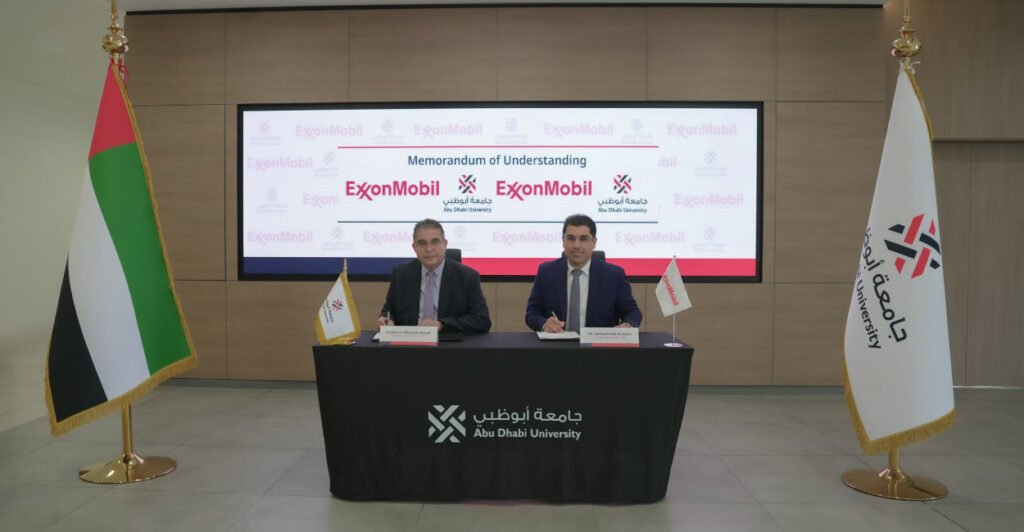
Abu Dhabi University just signed a fresh MoU with ExxonMobil. On paper it sounds like another corporate handshake. But dig a bit deeper and it’s actually one of the more useful moves I’ve seen for STEM and AI talent in the UAE, because it targets the exact gap most graduates fall into: the space between what you learn and what employers actually want you to know on day one.
Let me explain why I think it’s a bigger deal than the press release makes it sound.
What does the ADU and ExxonMobil partnership actually do?
The short answer: it links classroom learning to real industry work, funds students who need sponsorship, and expands programs like the ExxonMobil-ADU STEM Summer Camp.
The longer answer is more interesting. The agreement covers three things. Student sponsorships. Social responsibility projects. And a proper exchange of knowledge between academics and industry people who actually work in the field.
That third piece is the one nobody talks about enough. Universities everywhere have this problem where the syllabus is a couple of years behind what’s happening in the real world. In AI, “a couple of years behind” might as well be a decade. So when you get engineers from a company like ExxonMobil sitting down with faculty and helping shape what students actually study? That’s the thing that moves the needle.
Why should parents and students in the UAE care?
Because “STEM graduate” doesn’t automatically mean “employable graduate” anymore, and pretending otherwise isn’t doing anyone favours.
Here’s the thing. I’ve spoken to hiring managers in Dubai and Abu Dhabi over the years, and the same complaint keeps popping up. Fresh graduates have the theory. They can talk about neural networks or thermodynamics. But ask them to open a real project file, work with a messy dataset, or handle a client meeting, and they freeze.
This is the pain point. Not lack of intelligence. Not lack of effort. Just a missing bridge between the lecture hall and the actual job.
Partnerships like this one, when they’re done properly, are that bridge. Students get to work on live industry problems. They meet mentors who’ve been solving those problems for years. They build a network before they even graduate. And they walk into interviews with stories to tell instead of just grades to show.
How does this fit into the UAE’s push for AI and STEM talent?
It plugs directly into the “We the UAE 2031” vision, which basically says the country wants to move from an oil-based economy to a knowledge-based one, and it needs a small army of skilled locals and residents to do it.
You can’t build a knowledge economy on imported talent alone. Every serious country figured that out eventually. So the UAE has been pouring money into universities, AI research centres, and public-private tie-ups for years now. What ADU and ExxonMobil are doing sits right inside that strategy.
And honestly, ExxonMobil isn’t a random pick. Energy companies are quietly some of the biggest employers of AI and data science talent on the planet. Reservoir modelling, predictive maintenance, emissions optimisation, all of it runs on machine learning now. So a student sponsored through this program isn’t just getting oil-and-gas experience. They’re getting a front row seat to how AI gets used in a massive, complex, real-world operation.
That’s a resume line most graduates would kill for.
What kind of programs are already running?
The ExxonMobil-ADU STEM Summer Camp is the flagship one so far, and it’s been running for a while now.
It’s aimed at younger students, the ones still deciding whether STEM is even for them. And I like that focus, because a lot of the “STEM shortage” problem isn’t at university level. It starts way earlier, in the moment a 14 year old decides maths is boring and quietly gives up.
Camps like this exist to catch that kid before they check out. Hands-on projects, actual engineers walking them through what they do, a taste of what a career in the field looks like. It’s small in scale, but the compounding effect over ten or twenty years is huge.
Beyond the camp, there are the direct student sponsorships at ADU, which matter for families who might otherwise struggle with tuition for a full STEM degree. And now with the new MoU, both sides have committed to expanding applied learning, which I read as more internships, more capstone projects tied to industry, and more guest expertise flowing into the classroom.
Is a STEM degree in the UAE actually worth it now?
Yes, but only if you pick a program that pushes you outside the textbook.
Look, I’m not going to sit here and pretend every STEM degree is a golden ticket. Plenty of graduates still end up underemployed. The difference between the ones who land solid roles and the ones who don’t usually comes down to a few things. Did they do internships? Did they build a portfolio? Did they meet people in the industry before applying for jobs?
Programs that partner tightly with employers, like what ADU is building here, stack the deck in your favour. You’re not applying cold. You’re applying as someone who’s already been in the room.
That said, students still have to show up. No partnership on earth will save a graduate who coasted for four years. But if you’re motivated and you land in a program with these kinds of connections, the ceiling gets a lot higher.
The quiet win nobody’s talking about
Professor Ghassan Aouad, ADU’s Chancellor, said something in the announcement that stuck with me. He talked about learning that “extends beyond the classroom.” Corporate speak, sure. But there’s a real idea in there.
Universities used to be places you went to think. Then they became places you went to get certified. The best ones now are trying to become something else again, part lab, part launchpad, part professional network. Whether ADU pulls that off with ExxonMobil at scale is something we’ll only know in five years when we see where these graduates end up.
But the direction is right. And for a parent or student staring down the cost and time of a STEM degree, that direction matters more than any glossy brochure.
The UAE wants to build serious STEM and AI talent on home soil. This is one of the ways it happens. Not overnight, not perfectly, but brick by brick.
FAQs
1. What is the ADU ExxonMobil partnership about?
It’s a Memorandum of Understanding between Abu Dhabi University and ExxonMobil focused on student sponsorships, STEM social initiatives, and connecting academic learning with real industry experience to prepare graduates for STEM and AI careers.
2. Does ExxonMobil sponsor students at Abu Dhabi University?
Yes, ExxonMobil sponsors students pursuing STEM degrees at ADU, and the new agreement expands that support alongside applied learning opportunities and industry mentorship.
3. What is the ExxonMobil-ADU STEM Summer Camp?
It’s a joint program that introduces younger students to hands-on STEM experiences, with engineers and educators running projects designed to spark early interest in science, tech, engineering, and maths.
4. How does this partnership support the We the UAE 2031 vision?
The vision aims to make the UAE a knowledge-driven economy, and partnerships like this build the local STEM and AI talent pipeline needed to make that shift possible.
5. Are STEM jobs in demand in the UAE right now?
Yes, especially in AI, data science, engineering, and energy technology. Employers across Abu Dhabi and Dubai consistently report shortages in skilled STEM workers who also have real project experience.