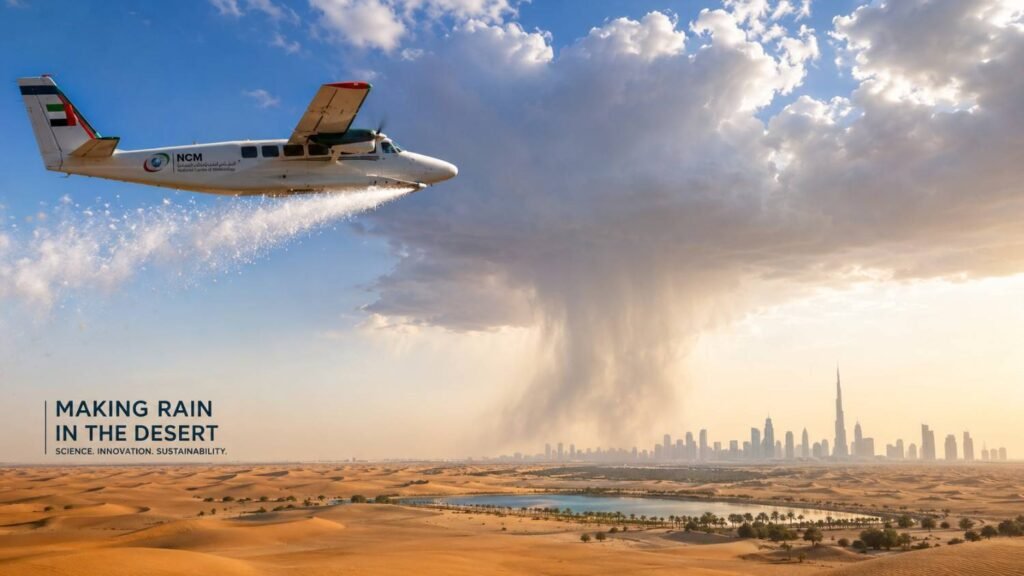
So the UAE doesn’t get much rain. Like, at all. That’s just how it is living in the desert. But instead of just accepting that, the government figured out they could basically nudge clouds into dropping more water. It’s called cloud seeding, and yeah, it’s actually a real thing they’re doing.
Here’s the basic idea. You’ve got clouds floating around with all this water vapor inside them. The problem is, that vapor doesn’t just turn into rain by itself. It needs something to grab onto. So what they do is shoot tiny particles into the cloud. The water sticks to those particles. More water piles on. Eventually it gets heavy enough to fall down as rain.
The National Centre of Meteorology is the outfit running this whole operation. They’ve got this research program, UAEREP, and they’ve spent years figuring out exactly how particles move through clouds and where you gotta release them to actually get results.
Why This Stuff Matters
Water costs money here. A lot of it. Most of what people use comes from desalination plants. You know what those do? They boil seawater to get fresh water out of it. Sounds simple enough but it takes tons of electricity and it’s expensive as hell.
If you can get 10 to 25 percent more rain naturally, that’s huge. You don’t gotta run the desalination plants as much. You save electricity. You save money. Your groundwater doesn’t get completely drained every year. That’s a win.
For people farming stuff, this is important. Farmers growing date palms in Abu Dhabi need water to actually grow their crops. More rain means better crops. Better crops means better money. For companies running businesses that need water, lower water costs is just straight up better for their bottom line.
What They Actually Use
They used to put flares on planes. These flares would burn and release salt crystals mixed with magnesium and stuff. Salt crystals love water. They attract it like crazy. So you’d get water sticking to the salt, droplets would form, they’d get bigger, and boom, rain.
It worked okay but it wasn’t great. You needed a bunch of flares per mission. The whole thing took time because the flares had to burn.
Then they came up with nanomaterials. These are super tiny particles. Like, way smaller than anything you can see. The thing about them is they work way better than the old flares. Like three times better. And they don’t need to burn. You just release them and they start working right away.
Scientists actually spent years testing different stuff in labs to figure this out. They measured how particles spread through clouds. They tested which ones actually worked. It wasn’t luck. It was actual research that paid off. Now they make this stuff locally too.
How They Actually Do It
The meteorologists at the NCM are constantly watching the weather. They use radar, satellites, cameras all over the place. They’re looking for specific clouds, ones that look like they’ll respond to seeding.
When they find one that looks good, they don’t just start dumping stuff into it. A plane goes up first to check it out. The pilot flies around the cloud, looks at how it’s structured, figures out where the best place to release the particles is. It’s like scouting before you go in.
Then the plane goes back and releases the material. They carry around 48 flares or containers of the nanomaterial stuff. The whole mission takes about three hours. Timing matters because you want to hit the cloud when it’s actively developing, when it’s most likely to respond.
New Stuff They’re Testing
The NCM isn’t just sticking with what they know works. They’re messing around with new approaches. One thing is electric charging, where they literally send electrical charges into clouds to make water droplets smash together and merge. Sounds wild but it actually makes sense from a physics standpoint.
They’re also bringing AI into the mix. Instead of having people make all the decisions, they’re training AI to look at cloud data and figure out when the conditions are perfect for seeding. Computers can process information way faster than people can. Better timing. Better results.
They’re also building computer models that simulate what happens inside a cloud. All the chemistry and physics and electrical stuff happening at the same time. By running these simulations, they can test different approaches without flying planes everywhere.
Some of the experimental stuff sounds like science fiction. Using jet engines to create updrafts. Lasers to make clouds form. Most of it’s still early stage but the point is clear. The UAE is serious about this. They’re combining business thinking with advanced tech to solve a real problem.
Why This Matters Long Term
Cloud seeding is part of the bigger picture. The UAE needs water. The population keeps growing. Businesses keep expanding. Agriculture needs consistent water. Without active management, you run out of water. That’s just how it works. Cloud seeding is one piece of that puzzle. There’s desalination, water recycling, conservation, all that stuff. But cloud seeding lets you work with nature instead of fighting it.
The fact that they’ve invested in research, set up local manufacturing, and keep developing new tech shows they’re not messing around. This isn’t temporary. This is a long-term strategy for water security. Operations keep running through 2026 and beyond, whenever conditions allow. As the tech gets better, results should improve too.
Questions People Ask
How much extra rain does this actually produce?
They’re aiming for 10 to 25 percent more. Not creating rain from nothing but definitely making clouds produce more than they would naturally.
Is this stuff safe?
Yeah, it’s safe. The particles are tested. Used in tiny amounts. They disperse naturally in the atmosphere. No buildup, no problems.
What if there’s no clouds?
Then nothing happens. Cloud seeding only works when clouds are already there. Can’t make rain from a clear sky.
Why doesn’t everywhere do this?
Some places do but it costs a lot. You need research facilities, planes, trained people, ongoing funding. Not every country has that or needs it like the UAE does.
How does AI help with this?
AI can look at weather data super fast and figure out when conditions are right for seeding. Removes the guesswork.
Is this new technology?
Cloud seeding’s been around since the 1940s. But what the UAE’s doing with nanomaterials is more advanced than most places.
Can they control where the rain falls?
Nope. Once clouds move, you can’t steer them. That’s why some areas get more rain than others even with seeding happening.
Who’s in charge of all this?
The National Centre of Meteorology. They’ve got the planes, equipment, and expertise.
How much does it cost?
Millions every year on research and operations. But it’s worth it when you think about how much water costs and what they’d spend on desalination instead.
What happens to the particles?
They’re designed to be harmless and disperse naturally in the atmosphere. No accumulation or environmental issues.