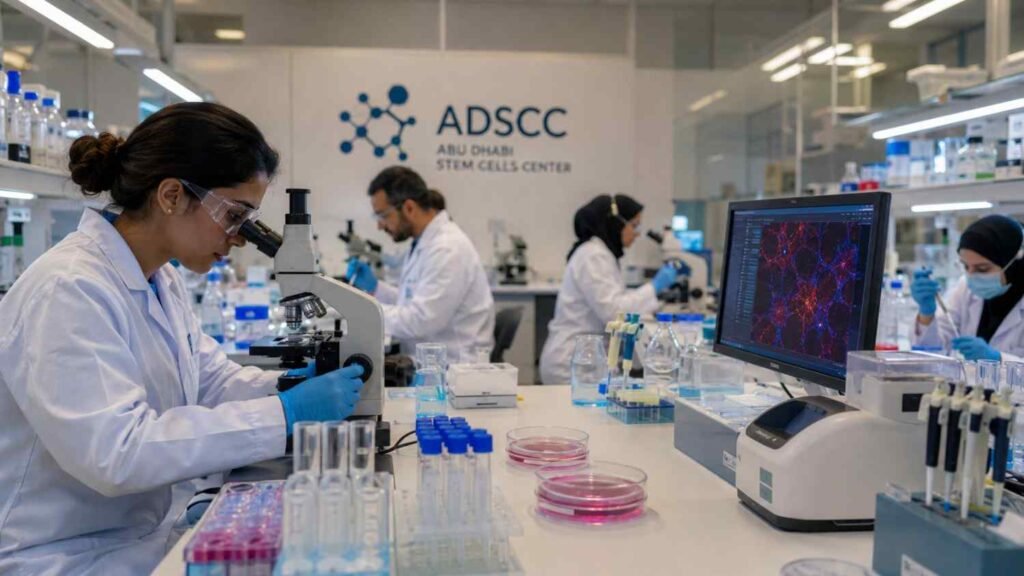
A team at the Abu Dhabi Stem Cells Center has found that Huntington’s disease attacks the brain’s support cells, not only the neurons that researchers have spent the last thirty years studying. The finding gives drug developers somewhere new to aim. They also tried three compounds on the damaged cells and watched them return to working normally, and one of those three is already sitting in Phase III trials for an unrelated illness, which is the part of this story that could realistically shorten the wait for a treatment.
Who This is for
If someone in your family has Huntington’s, or you carry the gene and you’re waiting to find out what happens next, you’re the reader this research speaks to most directly. It also matters to neurologists across the Gulf who get asked about new treatments and rarely have much to offer, and to anyone keeping track of where the UAE puts its research money.
Why Patients Remain Cautiously Optimistic
There’s a reason people in the first group tend to read this sort of news with their guard up. Breakthrough stories turn up every year or two, most of them stall somewhere between the lab bench and the pharmacy, and after enough of them you learn to ask a narrower question: how far along is this really, and what would have to happen for it to reach me? Those two questions are what the rest of this piece is about.
Why Decades of Huntington’s Research Kept Hitting a wall
Huntington’s comes from a single faulty gene that produces a damaged version of a protein called huntingtin. Over years, that protein wears the brain down, usually beginning with movement and going on to affect memory, thinking and behaviour. Nothing available today stops it. The medicines patients take now make the symptoms easier to live with and leave the cause alone.
Since the 1990s, nearly all the research has gone into neurons, which made sense at the time because neurons are the cells that die. Astrocytes were treated as background scenery. They probably shouldn’t have been, given that they make up most of the brain’s cells and their entire job is keeping neurons fed, balanced and working.
Why Scientists Shifted Their Focus to Astrocytes
Professor Angelo L. Vescovi, who led the study, said astrocytes turn out to play a far more critical role in how the disease progresses than researchers had assumed.
What the ADSCC Team Found
The short version: the mutant huntingtin protein stops astrocytes from holding their own shape.
The team traced that failure back to three molecular pathways which between them control how much Glial Fibrillary Acidic Protein an astrocyte can produce. GFAP is the internal scaffolding of the cell. When supply drops the astrocyte loses its structure, and once that happens it can’t do much for the neurons it’s meant to be supporting, so those neurons begin to fail too.
Researchers now have something concrete to work with. A named cell type, a named protein, and three points along the chain where a drug could plausibly interrupt the process.
How the Research Works, Step by Step
Most of this was done on tissue grown from patients rather than on animals, which is worth spelling out because it’s the reason the result carries weight.
- The team collected skin and blood samples from Huntington’s patients at various stages of the illness, children as well as adults.
- Those samples were reprogrammed into induced pluripotent stem cells, the kind that can be pushed into becoming almost any tissue in the body.
- From there the cells were grown into small pieces of brain tissue containing both neurons and astrocytes, each piece carrying the genetics of the patient it came from.
- Scientists watched the disease unfold inside those models, and that’s where the astrocyte damage showed up.
- To check that the protein was causing the damage rather than merely turning up alongside it, they introduced the mutant protein into healthy cells. The same faults appeared.
- Three compounds designed to repair the disrupted pathways went into the diseased astrocytes, and the cells recovered their structure and their function.
- Fruit flies engineered to carry Huntington’s backed all of this up. Untreated flies struggled to move and climb, while treated ones got a good deal of that motor function back.
Step five is the one other scientists will scrutinise hardest, because reproducing damage on demand inside a healthy cell is how you separate a cause from a bystander.
The Phase III Detail Worth Understanding
One of the three compounds is already in Phase III trials for a different condition, and that changes the arithmetic on timing.
Reaching Phase III means a drug has already been through human safety testing, which is the slow and expensive stretch of the process. If a compound that’s cleared that hurdle turns out to help with Huntington’s, whoever develops it starts much further down the road than they otherwise would have. Vescovi called it an opportunity to accelerate clinical translation. He’s being careful with his phrasing, and he ought to be, but the underlying point holds.
What This Does Not Mean Yet
Nobody living with Huntington’s should change their treatment on the strength of this, mainly because there’s nothing yet to change it to.
The paper hasn’t been published. ADSCC expects it to appear in a peer-reviewed journal, and until it does, other researchers can’t go through the methods properly. Everything described here happened in cultured tissue and in fruit flies, and plenty of compounds that repair cells in a dish do nothing once they reach a human brain.
What’s new is the target. There’s a mechanism to aim at now, plus one candidate drug already shown to be safe in people for unrelated reasons. That’s a better starting position than most Huntington’s research has had, though it remains a starting position.
Where Else This Platform Could Go
The stem cell system ADSCC built wasn’t designed only for Huntington’s. The centre expects it to speed up work on amyotrophic lateral sclerosis (ALS), Alzheimer’s disease, Parkinson’s disease, leukodystrophies, Alexander disease and sickle cell disease.
The reasoning is that any illness where you can take a sample from a patient and grow that same patient’s tissue from it becomes testable in ways it wasn’t before. Dr. Fatima Al Kaabi, who runs the Abu Dhabi Bone Marrow Transplant Program at ADSCC, described the value in terms of building research platforms capable of taking on genuinely complicated diseases.
How Abu Dhabi Is Building Long Term Research Capacity
That approach shows up elsewhere in how Abu Dhabi spends. The emirate has tended to fund infrastructure that keeps producing capability rather than one-off results, whether that’s autonomous vehicle monitoring or agricultural documentation programmes.
What Families Can Do Now
Nothing here calls for action, though a couple of things are worth doing anyway if you haven’t already.
Ask a neurologist about clinical trial registries. Trials for Huntington’s open and close fairly regularly and eligibility usually depends on what stage the disease has reached, so an answer from two years ago may no longer apply. If there’s family history and nobody has been tested, genetic counselling is the sensible starting point rather than a test on its own. And when the paper finally appears, read the paper. It will tell you considerably more than the coverage of it does.
Frequently Asked Questions
What did Abu Dhabi researchers discover about Huntington’s disease?
Scientists at the Abu Dhabi Stem Cells Center found that the mutant huntingtin protein disrupts three molecular pathways inside astrocytes, the brain’s support cells, which leaves them unable to make enough GFAP to keep their structure. Earlier research had focused almost entirely on neurons.
Is there a cure for Huntington’s disease now?
No. Huntington’s still has no cure and current medicines only manage symptoms. This work has been tested in lab-grown tissue and in fruit flies, not in patients.
What are astrocytes and why do they matter in Huntington’s?
Astrocytes are the support cells that make up most of the brain and keep neurons healthy. The ADSCC study suggests they lose their internal structure in Huntington’s, which would make some of the neuron damage a downstream effect rather than the starting point.
How soon could a treatment based on this research be available?
There’s no announced timeline. One of the three compounds tested is already in Phase III trials for another condition, which could shorten development if it works for Huntington’s too, but human trials for this particular use haven’t started.
How were the stem cells used in the study?
Researchers took skin and blood samples from patients, reprogrammed them into induced pluripotent stem cells, then grew them into brain tissue containing neurons and astrocytes. That lets them study each patient’s disease in a model built from that patient’s own cells.
Which other diseases could this stem cell platform help with?
ADSCC names ALS, Alzheimer’s disease, Parkinson’s disease, leukodystrophies, Alexander disease and sickle cell disease as conditions the same platform could accelerate research into.
Has the study been published?
Not yet. ADSCC says the findings are expected in a peer-reviewed scientific journal.