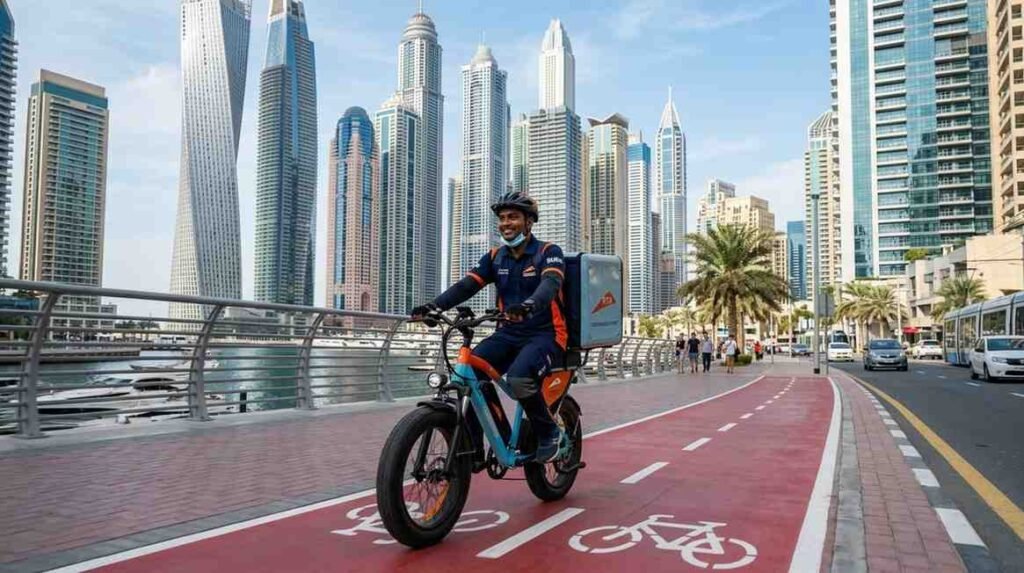
Dubai’s Roads and Transport Authority just opened up e-bike delivery to seven more neighborhoods. So now instead of four test areas, there’s eleven. The test run started in February. It went well enough that they decided to expand.
The new areas are Al Twar 1 and 2, Al Qusais 1, Sheikh Mohammed Bin Rashid Boulevard, Dubai Media City, Jumeirah Lakes Towers, and Dubai Marina. The original four were Al Karama, Al Hamriya, Umm Hurair, and Al Mankhool.
Why These Areas
The RTA didn’t just pick random neighborhoods. They looked at a few things. First, they needed places with actual cycling infrastructure already built out. No point putting bikes where there’s nowhere for them to go safely. Second, they checked where restaurants and shops were concentrated. Third, they looked at whether people in those areas were already using bikes or scooters. And fourth, they listened to what delivery companies actually wanted.
So basically, they picked places where it made sense.
How It Works for Businesses
If you run a restaurant or shop in one of these zones, you can now use e-bike delivery. The main advantage is speed. A bike doesn’t sit in traffic like a car does. In Dubai’s congested areas, that matters. If you run a restaurant or shop in one of these zones, you can now use e-bike delivery. The main advantage is speed. A bike doesn’t sit in traffic like a car does. In Dubai’s congested areas, that matters. It’s also another step in the city’s wider public transport upgrades, where smarter mobility solutions are helping people and businesses move around more efficiently. You get packages to customers faster. Customers like that.
Lower Costs and High Customer Satisfaction
There’s also the cost angle. There’s also the cost angle. If you’ve ever spent time driving through Dubai during peak hours, you know how quickly delays can add up. As projects aimed at improving Dubai Sharjah traffic relief continue, e-bikes give businesses a practical way to avoid congestion for shorter local deliveries. E-bikes are cheaper to run than vans or motorcycles. No fuel. No parking headaches. Just bikes and riders.
The RTA tested this for months. Customers were satisfied 99 percent of the time. The riders themselves were happy too, above 90 percent satisfaction. That’s not something you see often with new systems. Usually there are complaints.
The Rules
You can’t just throw a bike on the road and start delivering. The RTA has rules. Any delivery company using e-bikes needs to be licensed. They need to follow safety standards. They get monitored. The RTA worked with delivery companies to figure out what actually works, then they wrote rules around that.
If you want to use e-bike delivery for your business, work with a company that’s already licensed and compliant. Don’t just go with whoever’s cheapest. Make sure they’re actually following RTA standards.
Getting Started
If your business is in one of the eleven zones, you have a new option. Find a delivery partner that does e-bikes. Check they’re RTA approved. Set it up. That’s basically it.
The zones where this matters most are probably the ones with lots of foot traffic and restaurants. Places like Dubai Marina or media and business districts. If you’re in those areas and not using e-bike delivery yet, it’s worth looking into.
Questions People Ask
Is e-bike delivery available everywhere in Dubai?
No. Only in these eleven zones right now. Al Twar 1 and 2, Al Qusais 1, Sheikh Mohammed Bin Rashid Boulevard, Dubai Media City, Jumeirah Lakes Towers, Dubai Marina, Al Karama, Al Hamriya, Umm Hurair, and Al Mankhool. If you’re outside these, you’re stuck with regular delivery for now.
Why did the RTA expand to these specific areas?
They looked at where cycling infrastructure existed, where there were lots of shops and restaurants, where people already used bikes, and what delivery companies needed. These zones checked all those boxes.
How much faster is e-bike delivery?
Depends on distance and traffic. But in congested areas, bikes have a real advantage. They don’t get stuck the way cars do. The pilot showed 99 percent customer satisfaction, which suggests the speed was working.
What do I need to do to use e-bike delivery?
Find a delivery company that operates e-bikes in your zone. Make sure they’re RTA licensed. Set up an account. That’s it. Your delivery partner handles the rest.
Can I start an e-bike delivery business?
You need an RTA license. You need to meet their safety standards. You need to follow their operational rules. It’s not complicated, but it’s not unregulated either.
What can you deliver on e-bikes?
Food, packages, retail goods. Basically anything that fits on a bike and isn’t hazardous. Your delivery partner can tell you what they can handle.
How do I know if a delivery company is actually RTA approved?
Ask them directly. Check their license. Look for RTA compliance mentioned on their website or app. Don’t assume. Verify it.
Will more areas get e-bike delivery?
The RTA hasn’t announced anything yet. But the pilot worked well, so it’s probably coming. Keep an eye on their announcements.
What’s the environmental angle?
E-bikes produce zero emissions. They reduce fuel use and traffic. Good for the city. Good for your business’s carbon footprint if that matters to your customers.
Can customers track their delivery?
Most delivery companies have tracking through apps or text. E-bike deliveries are often faster, so you might see quicker updates. Ask your delivery partner what they offer.