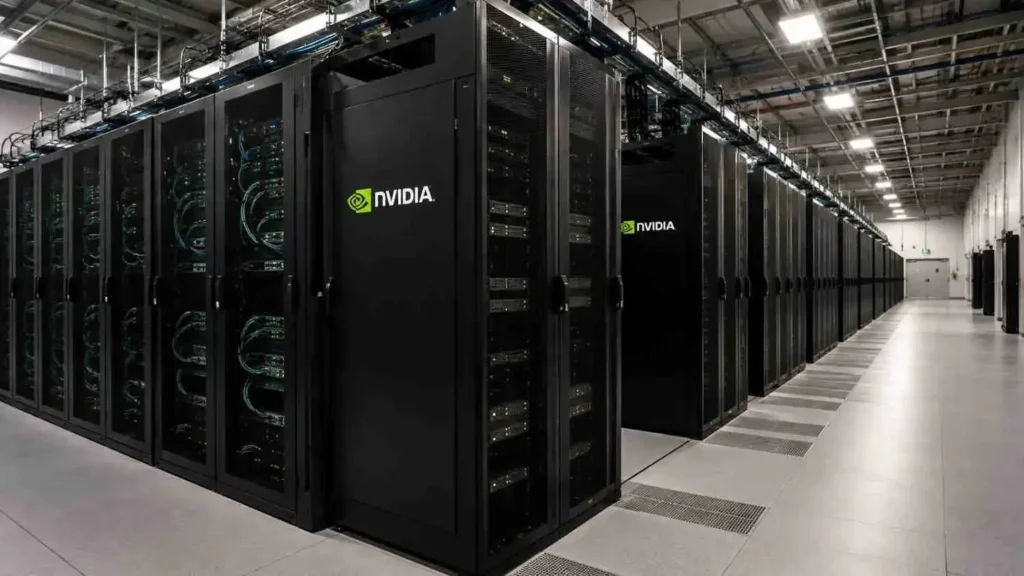
Sovereign AI infrastructure means a country runs its own AI systems on its own soil, using its own data, without depending on a foreign cloud provider. Abu Dhabi’s Aleria just proved the model works at scale. The company is expanding its Nvidia-powered AI infrastructure from the UAE into the United States, bringing up to 16,000 Nvidia Blackwell Ultra chips into US facilities while adding next-generation DGX Vera Rubin systems back home in the UAE.
This is not a plan on paper. Aleria’s systems are already live, running real workloads for government and critical infrastructure clients in both countries. That distinction matters, and it is the reason this story is worth understanding even if you have never heard of Aleria before today.
Who Sovereign AI Infrastructure Is For
Sovereign AI infrastructure is built for organizations that cannot legally or practically send their data to a foreign server. This includes government agencies, financial institutions, healthcare providers, energy and utility companies, and telecom operators. These sectors handle data that regulators require to stay within national borders, and many also run workloads too sensitive to trust to a shared public cloud.
Industries That Need Sovereign AI Infrastructure
If your organization falls into one of these categories, sovereign infrastructure is not optional. It is the only way to deploy AI while staying compliant. UAE businesses navigating similar data governance questions can see how this plays out under the UAE’s AI and Data Authority rules, which now treat data governance as a core compliance requirement rather than an afterthought.
How Aleria’s Sovereign AI System Works
Aleria’s model works by pairing Nvidia compute hardware with DDN storage systems, then wrapping the whole stack in a platform that governments and enterprises can operate without an in-house machine learning team. The infrastructure covers three layers: raw compute power, data management, and ready-to-use enterprise applications including video AI tools.
The Three Layers Behind Aleria’s Platform
The result is a system where a government agency or bank does not need to hire a team of AI engineers to get value from the hardware. Aleria delivers the compute, the storage, and the software layer as one package, already configured for production use.
This full-stack approach is what separates sovereign AI infrastructure from simply buying chips. Owning hardware without the software and operational layer around it does not solve the underlying problem. Aleria’s platform aims to remove that gap entirely, which is also why some UAE businesses are actively working to reduce dependence on a single AI vendor. Our earlier piece on escaping AI vendor lock-in covers the same underlying tension: control over infrastructure only matters if you also control how you use it.
What Is Actually Being Deployed
The expansion breaks down into two concrete numbers. In the United States, Aleria is deploying 8,640 Nvidia Grace Blackwell Ultra GPUs now, with plans to scale up to 16,000. This hardware runs large-scale AI training and inference workloads.
Aleria’s US and UAE Infrastructure Rollout
In the UAE, Aleria is adding 28 racks of Nvidia’s DGX Vera Rubin systems, Nvidia’s next-generation AI hardware platform. This marks one of the first deployments of this class of system anywhere in the region, putting the UAE among the earliest adopters globally rather than a follower market.
DDN supplies the storage layer at both sites, built to handle the petabyte-scale data movement that AI training requires. Without high-throughput storage, even the fastest chips sit idle waiting for data.
Why the US Deployment Matters for the UAE
A UAE-based company deploying advanced Nvidia chips inside the United States is notable on its own. For years, the conversation around AI chips and the Gulf region has run in the opposite direction, focused on whether UAE buyers could access advanced US chips at all. Our article on why the UAE still faces US AI chip export restrictions lays out how tightly controlled that flow has been.
Aleria’s move reframes the relationship. Instead of the UAE waiting on export approvals for chips built elsewhere, an Abu Dhabi company is now placing large-scale Nvidia infrastructure on US ground through a direct commercial partnership. It signals that sovereign AI capability built in the UAE has matured enough to expand outward, not just import inward.
Why This Expansion Is Happening Now
Aleria leadership was direct about the reasoning. The company did not enter the market with a pitch deck and a promise. It built working infrastructure in the UAE first, ran real national workloads on it, and used those results to justify the next phase. The US deployment and the UAE’s Vera Rubin rollout are framed as a continuation of something already proven, not a leap of faith.
Why Governments Are Investing in Sovereign AI
Nvidia’s regional leadership described sovereign AI infrastructure as the way nations manage their most critical asset: their own data. That framing explains why governments across sectors like energy, healthcare, and finance are the primary audience for this kind of deployment. Data residency is not a compliance checkbox for these industries. It is the foundation of national and operational security.
What This Means If You Run a UAE Business
You do not need to operate a data center to be affected by this shift. As sovereign AI infrastructure becomes standard for government and regulated sectors in the UAE, the businesses that work alongside them, as vendors, partners, or service providers, will increasingly be expected to meet the same data handling standards. Understanding how sovereign infrastructure works now puts you ahead of that requirement rather than scrambling to catch up later.
If your business handles regulated data or serves clients who do, start by mapping where your data currently sits and who has access to it. That single exercise reveals most of the gaps that sovereign AI infrastructure is designed to close.
The Bottom Line
Aleria’s expansion shows that sovereign AI infrastructure has moved past the pilot stage in the UAE. The systems are live, the workloads are real, and the model is now expanding into the United States rather than the other way around. For any organization handling sensitive or regulated data, this is a clear signal that sovereign, full-stack AI infrastructure is becoming the standard, not the exception.
Frequently Asked Questions
What does sovereign AI infrastructure mean?
Sovereign AI infrastructure means a country or organization runs its AI systems, including compute, storage, and applications, entirely within its own borders and under its own control, rather than relying on a foreign cloud provider.
What is Aleria and what does it do?
Aleria is an Abu Dhabi-based company that builds sovereign AI infrastructure using Nvidia compute hardware and DDN storage systems. It serves government agencies and national enterprises in sectors like finance, healthcare, energy, and telecom.
How many Nvidia chips is Aleria deploying in the US?
Aleria is deploying 8,640 Nvidia Grace Blackwell Ultra GPUs in the United States now, with plans to scale that number up to 16,000.
What is the DGX Vera Rubin system?
DGX Vera Rubin is Nvidia’s next-generation AI hardware platform. Aleria’s deployment of 28 racks in the UAE is one of the first installations of this system in the region.
Why do governments need sovereign AI infrastructure instead of using public cloud services?
Many government and regulated-sector workloads involve data that must legally stay within national borders. Public cloud providers based abroad cannot always guarantee this, making sovereign infrastructure a compliance requirement rather than a preference.
Does this Aleria expansion affect UAE businesses outside government and finance?
Yes, indirectly. As sovereign AI infrastructure becomes the standard for regulated sectors, vendors and partners working with those sectors are increasingly expected to meet similar data handling and residency standards.
Disclaimer
This article is intended for informational and educational purposes only. Information about Aleria, Nvidia, deployment plans, hardware specifications, and regulatory matters is based on publicly available announcements and reports available at the time of publication. Deployment timelines, infrastructure capacity, and government policies may change over time. Readers should consult official sources before making business, investment, technology, or compliance decisions.