Dubai just extended the deadline for the Mohammed bin Rashid Al Maktoum Global Water Award to September 30, 2026. If you’re working on water tech, this matters. The UAE Water Aid Foundation is backing projects with $1 million in funding, and they’re specifically interested in AI this year. The twist is that your solution needs to run on renewable energy.
This isn’t some obscure regional thing either. They’ve funded 43 projects across 26 countries already. Real money going to real problems.
What’s Actually Going On With This Award
The award started five years ago. It funds water technology that works at scale. Not prototypes. Not concepts. Actual deployable systems that solve real water problems in real places.
The money comes from the Mohammed bin Rashid Al Maktoum Global Initiatives. It’s a serious operation. They’ve put resources behind this because water scarcity is a genuine crisis in many parts of the world. The UAE knows this firsthand. They live in one of the driest regions on the planet.
How Previous Winners Have Made an Impact
Previous winners have tackled everything from desalination to water recycling to distribution efficiency. The common thread is that they all work. They all get deployed. They all serve people who need water.
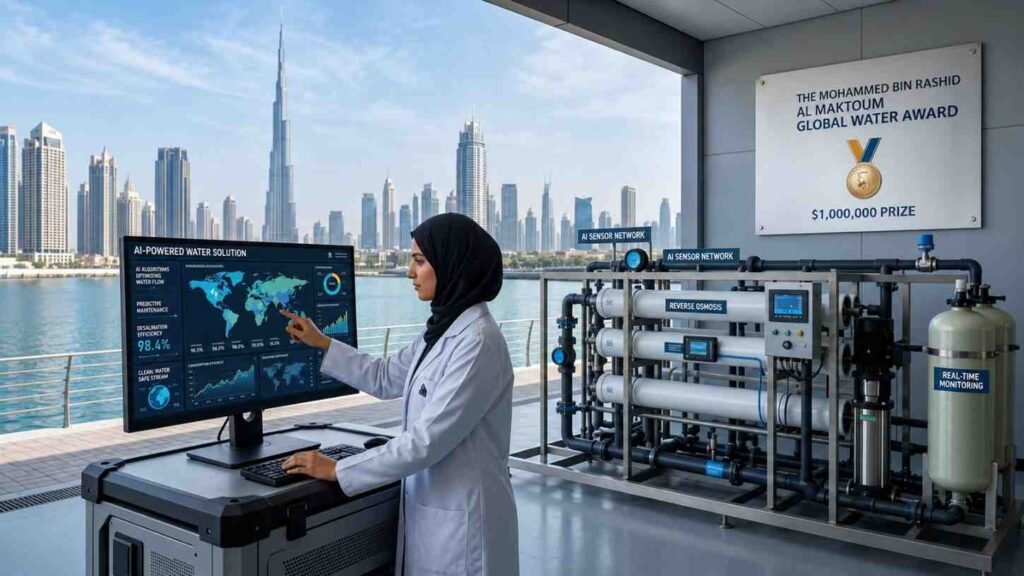
This year they’re pushing AI hard. That’s the new focus. They want projects that use machine learning to make water systems smarter. Predictive systems. Optimization algorithms. Real AI applications, not just slapping the word “AI” on something.
The Water Problem Nobody Wants to Talk About
Two billion people don’t have reliable access to clean water. That’s not some distant problem in poor countries. It’s happening everywhere. Even developed nations have water stress issues. California deals with it. Australia deals with it. The Middle East obviously deals with it.
Climate change is making it worse. Droughts are longer and more severe. Groundwater is running out faster than nature can replenish it. Population keeps growing. Demand keeps rising. Supply isn’t keeping up.
The UAE has already been experimenting with technologies that increase water security in extreme climates. Beyond desalination, authorities have invested in cloud seeding programmes to supplement rainfall and strengthen long term water management strategies.
Why Renewable Energy Matters
Desalination helps but it’s expensive and energy-intensive. You need massive amounts of power to turn salt water into fresh water. That’s why the renewable energy requirement matters. You can’t solve the water crisis by burning fossil fuels.
Water treatment plants lose water through leaks. Pipes break. Distribution systems are inefficient. A lot of treated water never reaches the people it’s meant for. It just leaks into the ground.
These are solvable problems. Technology can help. That’s what this award is betting on.
How AI Actually Gets Used in Water Systems
AI doesn’t magically create water. It makes existing water systems work better. Here’s what that looks like in practice.
Predictive Maintenance in Desalination Plants
Desalination plants have tons of equipment. Pumps, filters, membranes, cooling systems. Stuff breaks. When it does, the whole plant shuts down. Repairs take time and money. AI can look at sensor data and figure out when something’s about to fail. Maintenance crews can replace parts before they break. No downtime. No emergency repairs.
AI Applications in Water Distribution Networks
Water distribution networks have pipes everywhere. Old pipes. New pipes. Pipes under roads. Pipes under buildings. They leak constantly. Finding leaks is hard. Sometimes utilities don’t even know where the leaks are. AI systems can analyze pressure data and flow rates to pinpoint where leaks are likely happening. Then crews can fix them.
We’re already seeing this shift across the UAE, where smart monitoring centres are using artificial intelligence to track environmental conditions, identify irregular patterns, and improve the management of critical infrastructure. Similar approaches could eventually become standard across water networks worldwide.
Demand Forecasting and Resource Management
Treatment plants need to produce the right amount of water. Too much and you’re wasting resources. Too little and you can’t meet demand. AI models can predict demand based on weather, time of day, season, and other factors. Plants can adjust production accordingly. Less waste. Better efficiency.
These applications exist right now. They’re deployed in water systems around the world. The award is looking for more innovation in this space.
Who Can Actually Apply
Anyone can apply. Researchers. Companies. Startups. Universities. Nonprofits. You don’t have to be in the UAE. You don’t have to be in the Middle East. The award is open globally. Your project has to use renewable energy. Solar, wind, biomass, hydro, geothermal, or salinity gradient energy. That’s non-negotiable. The point is solving water scarcity without making the energy crisis worse.
Scalability Standards for Projects
Your project needs to scale. It can’t just work in one specific place under ideal conditions. It needs to work in different locations with different challenges. It needs to be adaptable. The deadline is September 30, 2026. That’s a few months away. If you’ve got something in the works, now’s the time to put together an application.
What This Award Says About the Future
The water industry is changing. It’s moving away from just building bigger infrastructure and moving toward using technology to be smarter with what exists. That shift is real and it’s accelerating.
The UAE is investing in this because they understand water security. They’ve built desalination plants, recycling systems, and conservation programs. They know what works and what doesn’t. They’re funding global projects because solutions from one region can work in others.
The AI focus shows where the industry is heading. Smart systems are becoming standard. Utilities are investing in them. The technology is getting cheaper. Projects that can show real results with AI are going to be competitive for funding.
If you work in water, this award is worth paying attention to. Even if you don’t apply, the winning projects show you what’s working and what’s getting funded. That’s useful information.
FAQ
What counts as an AI water solution?
Anything that uses machine learning to improve how water gets produced, treated, distributed, or conserved. Predictive maintenance. Smart networks. Demand forecasting. Optimization algorithms. The AI has to be integrated into a real system, not just a theoretical model.
How much money do winners get?
The total is $1 million split among multiple winners. How much each project gets depends on how many winners there are and how strong each project is. Previous winners have gotten different amounts based on their stage of development and scope.
Does the project have to be in the Middle East?
No. Winners have come from 26 different countries. Your project just needs to address water scarcity and use renewable energy.
Can I apply if my project isn’t finished yet?
Yes. They fund projects at different stages. You need a solid concept, a realistic implementation plan, and evidence that it will work. That could be research data, pilot results, or similar successful projects elsewhere.
How do I know if my idea is worth submitting?
Does it solve an actual water problem? Can it work in multiple locations? Does it use renewable energy? Is there evidence it will actually work? If you can say yes to all four, submit it.
When do winners get announced?
Usually a few months after the deadline. Previous cycles have taken until early in the following year. The evaluation process takes time.
Can individuals apply or just companies?
Both. Researchers, entrepreneurs, established companies, nonprofits, all of them have won before. What matters is the project quality and your ability to execute it.
Are there technology restrictions?
You need to use AI or machine learning. You need renewable energy. Beyond that, you have flexibility. IoT, cloud computing, edge AI, whatever works for your solution.
How competitive is it?
The last cycle got applications from 46 countries. Competition is real but there are winners. They’re not looking for perfection. They’re looking for projects that solve real problems and have a real chance of working.
What happens if you win?
You get funding to develop and deploy your project. You get global recognition, which helps with credibility and attracting more funding. Many winners use the award as a springboard for additional investment or partnerships.