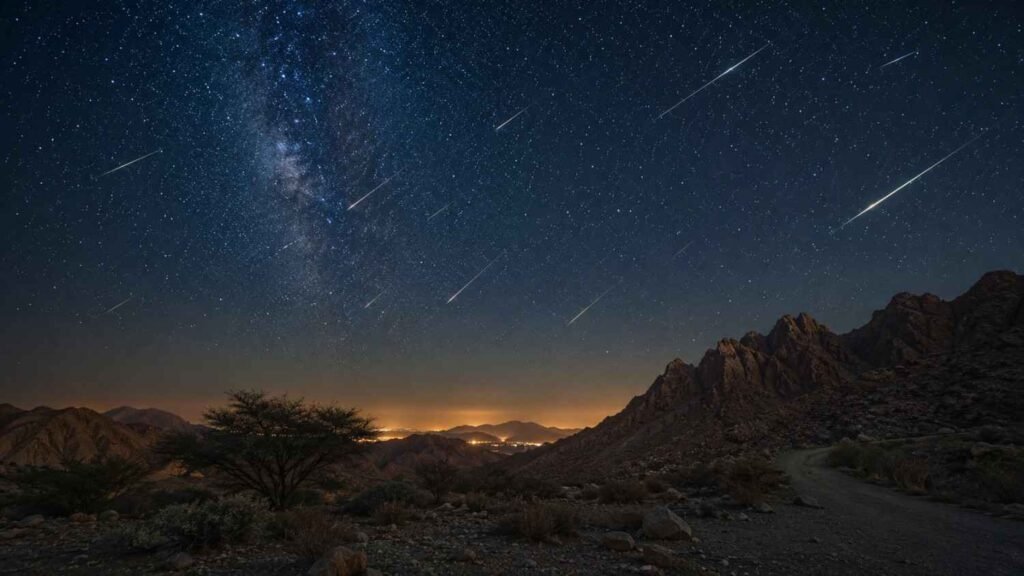
August 12 is the night to watch for. Peak of the Perseid meteor shower, right over the UAE, landing on top of a new moon. That combination means a darker sky than most years give you, and up to 100 meteors an hour once you’re clear of the city. Nothing to buy. No telescope, no binoculars. Just clear sky, and enough patience to sit still for a while.
When is the Perseid Meteor Shower in 2026
Wednesday, August 12 is peak night, running into the early hours of the 13th. Technically the whole shower stretches from mid-July to late August. Nobody plans their evening around the whole stretch, though, just that one night. Midnight to just before sunrise is your window, since that’s when the count climbs. Earlier in the night still gets you meteors. Fewer of them, though.
Why this Year’s Sky is Darker than Usual
This year’s new moon happens to land almost exactly on peak night. Less moonlight competing with the meteors, and that changes things more than most people expect. A bright moon usually drowns out anything faint, leaving only the strongest streaks visible. The Dubai Astronomy Group has flagged this as the darkest Perseids sky since 2018. Conditions like that don’t line up every year.
What’s Actually Causing the Shower
Comet Swift-Tuttle is behind all of it. Every August, Earth cuts through a belt of dust the comet left behind in its orbit, roughly 26 kilometres wide, a 133-year orbit around the sun, last close pass in 1992, next one not until 2126. It doesn’t have to be nearby for this to happen. The dust it already shed does that job on its own. Those particles hit the atmosphere at close to 59 kilometres a second and burn up almost on contact, and that’s your shooting star, right there. People call it the Perseid shower because the meteors look like they’re coming from the direction of the constellation Perseus. None of it poses any danger. Astronomers place the comet’s next close approach thousands of years out.
Where to Go to Actually See it
Getting a decent view comes down to how dark the sky really is, how open the horizon looks, and how far you’ve put yourself from city glow. Dubai’s own lighting alone washes out everything except the brightest meteors, so heading out of the city isn’t optional if you want a real count.
Inland desert and mountain areas hold up best for this. In Fujairah, Wadi Wurayah National Park works well; it’s a UNESCO World Heritage Site now, and it sits clear of the light spilling over from the coast. Near Al Ain, drive the road up Jebel Hafeet instead, and you climb above most of the haze sitting lower down. Or head toward Mleiha, in Sharjah’s interior, where it stays dark once you’re past the edge of town.
Arrive with time to spare before midnight. Eyes need a while to adjust, and open desert beats a spot boxed in by dunes or trees.
How to Watch it, Without Any Gear
Skip the telescope. Binoculars aren’t worth bringing either. A telescope only shows one small patch of sky at a time, and meteors give no warning about where they’ll show up next.
What actually helps: distance from artificial light, since even a short drive out changes what you can see. Twenty to thirty minutes sitting in the dark before your eyes properly adjust. Lying down instead of standing, because your neck won’t thank you after an hour of looking straight up. Keeping your phone dark, since one bright screen resets your night vision for several minutes. A jacket too. The desert temperature drops fast once midnight passes.
What Else is Up there This Month
Saturn hangs around for most of the night. Mars rises before sunrise. You won’t need anything beyond your own eyes for either one. Uranus and Neptune are up there too, technically speaking, but both stay too faint without a telescope pointed right at them. There’s also Comet 10P/Tempel 2, closest to the sun on August 2, though spotting it takes binoculars or a telescope plus a sky dark enough to actually see it. Worth staying out for anyway.
Camera Settings if you Want to Shoot it
Manual mode on a DSLR or mirrorless camera is what actually gets you a usable shot. Start with a tripod, because a long exposure blurs from even the slightest shake. A wide-angle lens helps too, simply because it takes in more sky at once. Keep your hands off the camera during the exposure itself; a remote shutter or intervalometer does that for you. And carry spare batteries. Long exposures burn through them faster than you’d think.
Autofocus off. Focus by hand instead, locked onto a bright star, a planet, or the infinity mark on the lens barrel. Point the frame toward Perseus, since that’s the radiant. f/2.8 or wider for aperture. Fifteen to thirty seconds of exposure. ISO 1600, higher if needed. On humid nights, a lens heater is worth having. It keeps condensation from fogging the glass halfway through a shoot.
Check the Sky Before you Drive Out
Dust or cloud cover can undo a clear forecast fast, so it pays to check before driving out. Check the UAE weather forecast first; it tells you fast whether the sky’s staying clear on the night of the 12th.
FAQs
When is the best time to see the Perseid meteor shower in the UAE in 2026?
Late on August 12 into the early hours of the 13th. Meteor counts climb highest after midnight.
Do you need a telescope to see the Perseid meteor shower?
No. Eyes alone catch more than a telescope would here, since a telescope only shows a narrow slice of sky at once.
Where can you watch the meteor shower away from Dubai’s city lights?
Anywhere inland beats the city for this. Wadi Wurayah in Fujairah, Jebel Hafeet near Al Ain, and the Mleiha desert in Sharjah are all solid choices.
How many meteors per hour can you expect this year?
As many as 100 an hour, if the sky stays clear and dark. This year’s new moon pushes that number higher than usual.
Why does the new moon matter for this year’s shower?
Without moonlight, fainter meteors stay visible instead of getting washed out. Skies this dark haven’t happened since 2018.
What causes the Perseid meteor shower every year?
Comet Swift-Tuttle left a dust trail behind, and Earth crosses through it every year. The particles burn up fast in the atmosphere, which is what produces the streaks of light.