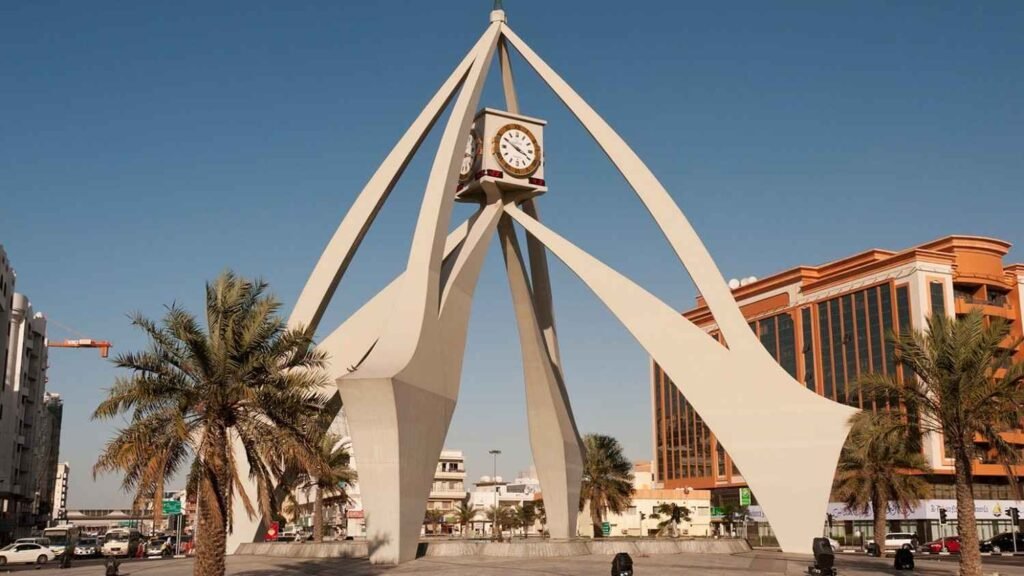
The Deira Clock Tower is a roundabout in Al Rigga, and it is one of the oldest things still standing in Dubai. It went up in the 1960s, back when the Creek was the centre of everything and Sheikh Zayed Road was still desert. For a long stretch, this was the shape people drew when they drew Dubai.
You can’t go inside it. You can’t even walk up to it. Cars circle it all day and you look at it from the pavement, which catches a lot of first time visitors off guard.
Still worth a stop, though. Almost everything Dubai shows off was finished after 2005. This one predates the union, survived being rebuilt from scratch, and got a ten million dirham facelift in 2023. Not much else in the city can say that.
Below: where it sits, who put it there, why two different official sources give two different build dates, the drill bit story that refuses to die, what the 2023 work actually did, and how to see it without losing an hour to traffic.
Where it is and How to Get There
The tower sits where Umm Hurair Road meets Al Maktoum Road, in Al Rigga, one of the older pockets of Deira. Traffic off the roundabout feeds onto Al Maktoum Bridge. That bridge was the first road link ever built between Deira and Bur Dubai, which is the whole reason the junction mattered.
By Metro
Although Al Rigga Station on the Red Line is the closest stop, travellers exploring other parts of old Dubai often combine the visit with stations on the Dubai Metro Green Line, especially when heading towards the Creek and the traditional souqs.
Take the Metro. The roads here stay heavy well past what you’d call rush hour.
By Car
Parking is the catch. Nothing is set aside for the tower, so you’re looking at paid street bays on the smaller roads off Al Rigga Road, or a paid basement in one of the office buildings nearby. Pay through the RTA app instead of hunting for a working machine, and check the hours, because tariff rules shift on Fridays and public holidays.
And don’t slow down on the roundabout for a photo. Lane changes here are aggressive, and stopping is an offence on top of being a bad idea.
A Clock Nobody Had a Use For
The story behind it is better than the landmark’s reputation. Sometime in the early 1960s, Sheikh Ahmed of Qatar, who had married into Sheikh Rashid’s family, sent him a clock. Not a mantelpiece clock. An enormous one, with no obvious building to put it on.
That account comes from Edgar Bublik, an engineer who ran Overseas AST in Dubai through the 1970s. He said his predecessor, a Mr Bulard, had just wrapped up Zabeel Palace for Sheikh Rashid and drew up the idea of a tower to hold the thing. The sketch went off to an engineer for the structural maths, and that was that.
Wikipedia credits Otto Bullard alongside the Lebanese architect Ziki Homsi of Architecture Design Construction. The location wasn’t sentimental. Back then the main roads into Dubai converged right at that point, before the Dubai to Abu Dhabi road rearranged everything.
1963 or 1965?
Both dates are floating around and both come from sources you’d normally trust. Dubai Municipality says 1963. Wikipedia says 1965. Nobody has ever bothered to reconcile them.
There’s a third date that muddies it further, and honestly it’s the more interesting one. The original was built with concrete mixed by hand, standard practice then, not great for longevity. It corroded. In 1970 the tower was largely rebuilt, same material, better methods.
So if you want a clean answer: 1960s, and most of what you’re looking at is the 1970 rebuild of the original design.
No, it isn’t an Oil Drill Bit
Someone will eventually tell you the shape was meant to echo a drilling bit, a nod to the oil years. Good story. Not true.
Bublik dealt with this directly. He said the design came out of Bulard’s own head and wasn’t meant to represent a drill bit or anything else. The four legs curving up into the clock head were just a design decision.
What the Shape is Actually For
The UAE Ministry of Culture describes it as a minimal structure with no ornamentation at all. Four arches carry the weight, working as buttresses, and they meet at the top to hold the four clock faces.
The useful bit is the gap underneath. Because the base is hollow, drivers going around the roundabout can see straight through it. The monument never blocks the view of oncoming traffic, which for a structure sitting in the middle of a junction is not a small thing.
The Ministry calls this form following function, the modernist idea that a building’s shape should come from its job rather than from decoration. Those arches are typical of regional modernism, the style that ran through a lot of Gulf public architecture in that period. Stand on the corner for two minutes and you can see the logic without anyone explaining it.
The Clock is Newer than the Tower by a Long Way
Here’s the detail almost nobody knows. The original mechanism is gone. Since 2010 the tower has run on a GPS controlled clock, supervised and operated by Omega.
Meaning it pulls its time from satellites rather than gears, so it doesn’t drift and nobody climbs up to correct it twice a year.
What the 2023 Restoration Changed
Dubai Municipality started work on the roundabout in May 2023 and finished by the end of August. The AED 10 million project formed part of the Dubai 2040 Urban Master Plan, which aims to modernise public spaces while preserving the city’s cultural landmarks.
Most of the work went into the setting rather than the tower:
- New flooring across the roundabout
- A redesigned water fountain as the centrepiece
- A 3D lighting system on the structure
- New planting and landscaping around the base
Dawoud Al Hajri, Director General of Dubai Municipality, said the goal was a modern face that still fit the country’s cultural and historical character. For anyone visiting, the practical upshot is that the site is now worth seeing at night, which it really wasn’t before.
How to Actually Visit it
Time of Day
Evening. The lighting and the fountain are the draw now, and the tower photographs far better against a dark sky than under midday glare. Sunset to about an hour after works best, when there’s still some colour up there and the lights are already on.
If you’re planning an evening around the area, the Clock Tower pairs well with several free things to do in Dubai at night, especially a walk through Deira and along Dubai Creek after sunset. Early morning is fine too if you want the structure on its own without the noise. Before nine on a weekend, roughly.
Time of Year
October to April, no question. Standing outside in Deira between June and August is genuinely unpleasant, humidity included, so if you’re here in summer keep it to a few minutes and plan where you’re ducking into air conditioning afterwards.
Early December is worth a mention. Landmarks around the city usually get extra lighting around National Day.
Photos
The Al Rigga side pavement gives the cleanest angle, with fewer overhead cables cutting through the frame. Bring something wide, because you’re shooting a tall object from close up with nowhere to step back. Drop low near the kerb if you want the fountain in the shot.
Leave the drone. Flying one in Dubai needs proper permission and this is a dense area next to main roads.
Set your Expectations
Fifteen minutes, tops. No ticket, no entry, no visitor centre, nothing to buy. Come here expecting an attraction and you’ll wonder why you bothered. Come here as one stop on a longer walk through Deira and it makes sense.
Make it Part of a Half Day
The tower works much better inside a route. Simple version: start at Al Rigga station, see the Clock Tower, then head into the older part of Deira for the Gold Souq and the Spice Souq. Short walk or a very short taxi.
From there take an abra across the Creek to Bur Dubai. Costs a couple of dirhams and it’s still one of the better things you can do in this country for the money. On the far side you’ve got Al Fahidi Historical Neighbourhood, the museum area and Al Seef.
You end up making the same crossing the Clock Tower roundabout was built to serve, except by boat.
Why it Counts as Heritage
The Ministry of Culture has put the tower on the UAE National List of Modern Architectural Heritage. That register documents buildings and sites of cultural value, weighted towards 1960 to 1990, and pushes for their protection.
Which is a shift worth noticing. Heritage in the Gulf usually means coral stone and wind towers. This register accepts that concrete from the oil years carries history too, and the Clock Tower is about as clear an example as you’ll find.
It’s had outside attention as well. The Telegraph once listed it among seventeen of the most beautiful clock towers in the world. There’s also a copy of it standing in Bahria Town, Lahore, which tells you something about how far the silhouette travelled.
Final Thoughts
This won’t be the highlight of anyone’s trip and it doesn’t need to be. It’s a short stop that gives the rest of the city some context, and context is harder to come by in Dubai than you’d think.
With its restored lighting, landscaping and renewed public space, the Clock Tower has quietly reclaimed its place among Dubai’s attractions that have recently reopened or been refreshed, making it a worthwhile stop even for visitors who’ve been to the city before.
Go in the evening. Stand on the Al Rigga side for a few minutes, then keep walking towards the souqs and the water.
Frequently Asked Questions
Where is the Deira Clock Tower located?
At the junction of Umm Hurair Road and Al Maktoum Road in Al Rigga, Deira, Dubai. Nearest Metro stations are Al Rigga and City Centre Deira, both on the Red Line.
When was the Deira Clock Tower built?
In the 1960s. Dubai Municipality gives 1963, other records give 1965. The tower was largely rebuilt in 1970 after the original hand mixed concrete corroded.
Can you go inside the Deira Clock Tower?
No. It sits in the middle of a working roundabout with no interior access. You view it from the pavements around the junction.
Is there an entry fee?
No. It’s a public landmark on a road junction and free to view at any hour.
Why is the Deira Clock Tower famous?
It’s one of the oldest surviving landmarks in Dubai and it marked the route to Al Maktoum Bridge, the first road crossing between Deira and Bur Dubai. It stood as a symbol of the city decades before the modern skyline.
Was the tower designed to look like an oil drill bit?
No. Engineer Edgar Bublik stated the shape came from the architect’s own ideas and wasn’t meant to represent a drill bit or any other object.
What changed in the 2023 renovation?
Dubai Municipality spent ten million dirhams between May and August 2023 on new flooring, a redesigned fountain, a 3D lighting system and fresh landscaping around the roundabout.
Is the clock accurate?
Yes. The original mechanism was replaced with a GPS controlled clock, running under Omega’s supervision since 2010, so it takes its time from satellite signal.
How long should I spend there?
About fifteen minutes. Pair it with the Gold Souq, the Spice Souq and an abra ride across the Creek to fill out a half day.
Where can I park?
No dedicated car park exists. Use paid street bays on the side roads off Al Rigga Road and pay through the RTA app, or skip the car and take the Metro.