I have driven out to Khorfakkan more times than I can count, and I still manage to get the timing wrong on about half of them. So this is the version I wish somebody had handed me the first time.
Khorfakkan sits on the UAE east coast facing the Gulf of Oman. It belongs to Sharjah, not Fujairah, which confuses almost everyone. From Dubai it is roughly two hours in the car. Do the Al Rabi trail at first light, spend the hot middle of the day at Al Rafisah Dam or up in Wadi Shees, then come back down for the amphitheatre after dark.
That’s also why I never think of it as a standalone destination. If you’re exploring other tourist places in Sharjah, you’ll notice Khorfakkan offers a completely different side of the emirate, with mountains and beaches instead of the city’s museums and heritage districts.
Why write another one of these? Because the mountain road opened in 2020 and changed the whole calculation, and a lot of what you find online still describes the old version of this town. Half the listings you will read are actually Fujairah attractions filed under a Khorfakkan heading. That is how people end up standing at a waterfall for ten minutes at one in the afternoon, sweating, wondering what the fuss was about.
Here is what I would tell a friend.
The Drive Is Part of It
The Sharjah to Khorfakkan road is, in my opinion, the best stretch of tarmac in the country. It cuts straight through the Hajar mountains, including a long tunnel bored through the rock, and there are proper pull in bays where you can stop and look back down the valley.
Two hours from Dubai is realistic. From Sharjah city, closer to ninety minutes. Abu Dhabi is three hours plus, at which point I would honestly just book a room and stay over.
Things I learned by not doing them. Fill the tank on the city side, because petrol stations get sparse once you are into the hills. After making a couple of avoidable mistakes on earlier drives, I started following the same routine I’d use for any long journey. A quick UAE road trip safety checklist, checking tyre pressure, fuel, navigation, and emergency supplies, makes the mountain drive far less stressful. Signal drops out in the wadis, so download your map before you go if you rely on it. And the Friday and Saturday evening run back into town is grim. Leave by four or hang around until eight, but do not aim for six.
No train, no metro. There are buses to the east coast from Sharjah but they take forever. Drive.
The Amphitheatre and That Waterfall
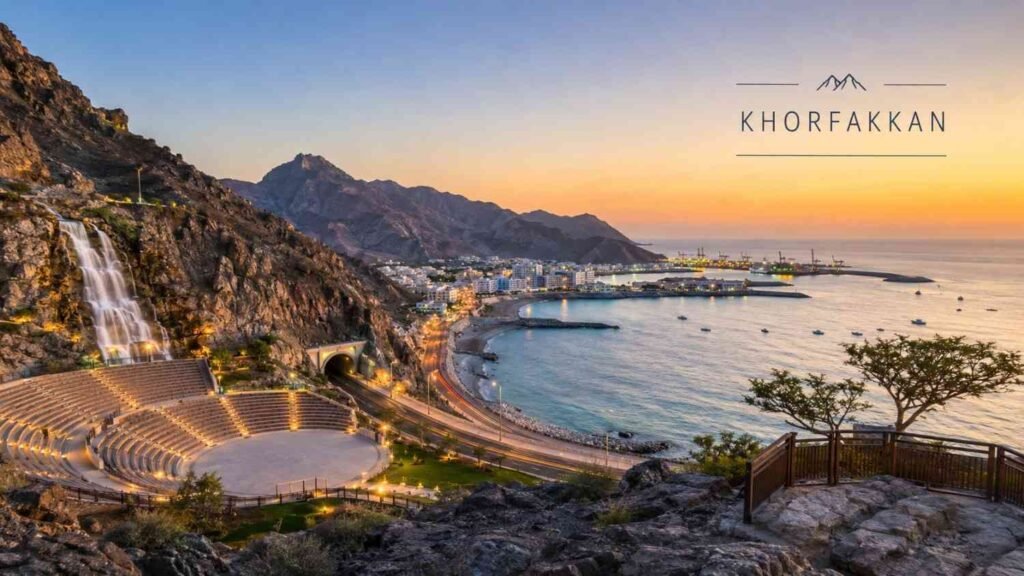
This is the postcard shot. A Greek and Roman style amphitheatre built into the hillside, a man made waterfall pouring down the rock next to it, the road curving underneath and the bay behind.
Let me be straight about the waterfall though. It runs on a pump. It is smaller in real life than the photos suggest and you will be done looking at it in about five minutes. What actually works is the whole composition, especially at night when the lighting comes on and the heat has finally dropped off.
So go in the evening. Parking sits right underneath and it fills up fast on weekends, so get there before seven or resign yourself to a walk.
Al Rabi Hiking Trail
Best free thing in Khorfakkan, and the one people consistently underrate. You climb from near the Corniche up to a restored watchtower, and the view from the top takes in the town, the port and the open water.
You will see it described as suitable for beginners. That is being kind. The path is clear and well built, but it is steep, there is no shade to speak of, and the surface is loose in places. Sixty to ninety minutes up and down for most people.
A few things that will save you grief:
- Sunrise or the last two hours of daylight. Between May and September, midday on that trail is not a comfort problem, it is a safety one.
- More water than you think you need. There is nowhere to buy any once you start climbing.
- The lower path on the way back down has washed out in sections. Take it slow.
- You will probably see a lizard or two, maybe a snake. They want nothing to do with you. Just watch where you put your hands.
- Carry your bottles back down. The bins near the top overflow and the litter up there is getting bad.
One more thing. Wear real shoes. I have seen people attempt this in flip flops and it does not go well.
Al Rafisah Dam
Ten minutes inland, a reservoir with mountains standing over it on all sides. Of everywhere in Khorfakkan, this is the spot that feels least like the rest of the UAE.
There is a path around part of the water, shaded seating, a cafe, and a restaurant looking out over the lake. You can hire a kayak or a pedal boat at the counter. Prices are reasonable, but hours shift with the season, so a quick call ahead in summer saves a wasted drive.
Families love it, which means weekends are busy rather than peaceful. Go on a weekday morning and you will practically have it to yourself.
Wadi Shees and Shees Park
Up in the mountains, inland. A few dirhams a head to get in, and for that you get walkways cut into the cliff face, a small waterfall, barbecue spots, a play area and a cafe.
The bit I find most interesting is the falaj system running through the old village. Those are the traditional stone channels that carried mountain water down to the farm terraces, and they were doing that job for a very long time before anyone thought about landscaping it for visitors. Worth a proper look rather than a photo.
Take a jacket in winter. It genuinely gets cold up there after sunset by our standards, which is not a complaint, because how often does that happen here.
If you’ve got another half day to spare, I usually keep driving toward Hanging Garden Kalba. It’s close enough to pair with Wadi Shees, and the cooler mountain setting gives the whole east coast trip a different feel without adding hours to the journey.
Al Suhub Rest House
High on the mountain above the town, with a cafe and a viewing deck that looks straight down over the bay. The road up is steep but properly surfaced, so a normal saloon car is fine. No need for a four wheel drive.
This is my pick for sunset, ahead of the beach, because you are looking out across the water instead of into the hills. On a clear evening you can pick out the ships sitting offshore waiting their turn at the port.
The Corniche and the Beaches
Khorfakkan Beach runs the length of the town. Long promenade, grass, play areas, food outlets behind. The water here is calmer than the Gulf side and the sand is decent, so it works well if you have small kids.
Luluyah, a little to the north, is quieter. Neither one charges you anything.
Now, something I would rather say plainly than have you find out awkwardly. This is Sharjah. The dress code in public is more conservative than what you are used to in Dubai. Swimwear in the water is fine, but throw something on when you head back to the car. Nobody is going to confront you about it. It is simply what is expected, and it costs you nothing to go along with it.
Getting in the Water
The east coast has the clearest water in the country and Khorfakkan is one of the easiest places to reach it. There are dive centres in town doing shore dives, boat dives and courses, and you can snorkel straight off the beach without booking anything.
Green turtles are common. Most people who go in a few times will see one. Visibility is better from October through to April, which happens to also be when you actually want to be in the sea.
Small correction while I am here, because guides get this wrong constantly. Snoopy Island is not in Khorfakkan. It is further north at Al Aqah, in Fujairah, maybe half an hour up the coast.
Rules Worth Knowing Before You Set Off
Sharjah does not permit alcohol, and Khorfakkan is Sharjah. There is no licensed venue in town, so do not build an evening around one, and do not carry any through the emirate.
Modest dress applies generally, not only at the beach. Shoulders and knees covered is the safe bet for everyone once you are away from the sand.
During Ramadan the rules on eating and drinking in public during daylight apply, and opening times for parks and cafes move around. Check before you drive out rather than assuming.
Flying a drone needs permission, and keep well away from the port. It is a working container terminal, not scenery.
When to Go
October to April, and if you can pick, December to February. That is when you can hike at eleven in the morning without regretting it.
Summer still works, you just have to be disciplined about it. On the trail before eight, indoors or at the dam through the worst of the heat, back out after five. I have done it in August and it was fine. It was also not relaxing.
Rain is rare but it happens in winter, and when it does the wadis can run fast and hard. If it has rained recently, stay out of the wadi beds. That is not a dramatic warning, it is just how flash flooding works here.
If You Only Have One Day
This has become one of my favourite weekend activities in the UAE because you get beaches, mountains, hiking, and scenic drives in a single trip without needing to book a flight or spend an entire weekend away from home.
This order works and stops you doubling back on yourself:
- Out of the city by six thirty, one stop on the mountain road.
- Al Rabi trail on arrival, while it is still cool. Ninety minutes.
- Coffee and breakfast on the Corniche after.
- Al Rafisah Dam for a couple of hours.
- Up to Wadi Shees early afternoon.
- Back down for sunset at Al Suhub.
- Amphitheatre and waterfall after dark, then home.
That said, two days is better. There are hotels in the town itself and resorts spread along the coast toward Fujairah, and staying over takes the pressure off the whole thing. Winter weekends book up, so do not leave it until Thursday.
Eating
Khorfakkan is not a fine dining town. It does not pretend to be. What it does well is honest Lebanese, Indian and Emirati food at prices that will surprise you if you have been eating in Dubai, plus fish that came off a boat somewhere nearby.
The Corniche restaurants and the cluster tucked behind the waterfall are the safe picks, and a few of them have terraces facing the sea. Al Rafisah and Shees both have cafes on site, so you are not forced to drive back into town at lunchtime.
Final Thoughts
The mistake almost every first timer makes is treating Khorfakkan as one stop on a bigger east coast loop. You roll in at midday, look at the waterfall, take the photo, and leave thinking there was not much to it.
Give it a full day instead. Start on the trail before the sun is properly up and the place turns into one of the better weekends you can have without leaving the country. Bring water, bring a layer for the mountains in winter, and take your rubbish home.
Frequently Asked Questions
How far is Khorfakkan from Dubai?
About 130 kilometres, which is roughly two hours by car on the Sharjah to Khorfakkan mountain road. Add time for weekend evening traffic on the way back.
Is Khorfakkan in Sharjah or Fujairah?
Sharjah. It sits on the east coast with Fujairah territory around it, but it is administratively part of Sharjah, and Sharjah rules apply. That includes no alcohol.
Is one day enough?
Yes, if you leave early. One day covers the trail, the dam and the amphitheatre comfortably. Two days lets you add Wadi Shees and an unhurried afternoon at the beach.
Is the waterfall natural?
No, it is man made and pump fed, built alongside the amphitheatre. It looks best at night as part of the wider setting.
Do you have to pay to get in anywhere?
Most of it is free, including the beach, the Corniche, the Al Rabi trail and the amphitheatre grounds. Shees Park charges a small entry fee per person, and activities such as kayaking at Al Rafisah are paid separately.
Can you swim at the beach?
Yes. Calm water, family friendly, no entry fee. Cover up once you are out of the water, in line with Sharjah norms.
Best time of year?
October through April, with December to February being the most comfortable months for hiking and spending the day outdoors.
Are there hotels?
There are hotels in Khorfakkan itself and more resort options along the coast heading toward Fujairah. Book ahead for winter weekends and public holidays.